Los cables blindados y no blindados son ambos tipos de cables de alimentación., y son los dos tipos de cables de alimentación más utilizados. Cables de alimentación todos consisten en conductor, aislamiento del conductor, y capa protectora exterior.
Él diferencia entre cables armados y cables no armados radica en la presencia o ausencia de una capa de armadura. Comparado con cables no blindados, Los cables armados tienen un adicional estructura protectora metálica, ofreciendo una mayor resistencia a la presión, impacto, roedores, y resistencia a la tracción. Se pueden utilizar en entierro directo., exterior, y entornos industriales hostiles.
Basado en años de experiencia en proyectos en el extranjero, ZMS Cables ha descubierto que la mayoría de los fracasos en los proyectos no se deben a problemas de calidad del producto, sino más bien a escenarios de aplicación incorrectos y configuraciones de armadura incompatibles., llevando a retrabajo. Este artículo proporcionará un análisis en profundidad de estos dos tipos de cables para ayudar a los clientes a mitigar los riesgos..
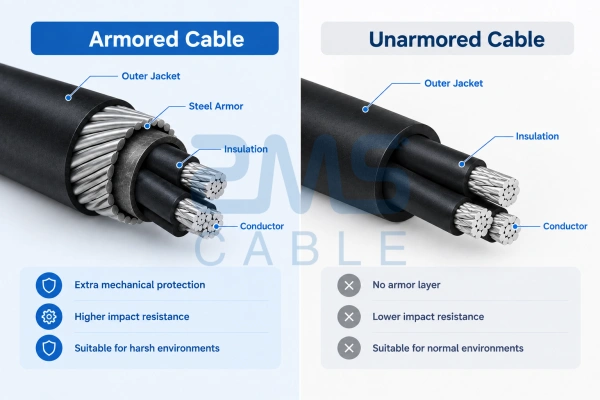
¿Qué es el cable armado??
¿Qué es el cable no blindado??
Cable blindado Es un cable de alimentación reforzado con una capa de armadura metálica adicional entre la capa de aislamiento del cable y la funda exterior.. Los materiales de armadura comunes son cinta de acero y alambre de acero.; La armadura de cinta de aluminio también se puede utilizar según los requisitos..
La estructura general del cable armado., desde adentro hacia afuera, incluye:
Conductor → capa de aislamiento → capa de revestimiento interior → capa de armadura metálica → funda exterior.
La capa de armadura metálica no cambia la conductividad del cable, pero puede resistir fuerzas externas como la compresión., impacto, tensión, y mordeduras de animales, al mismo tiempo que proporciona un cierto grado de blindaje electromagnético.
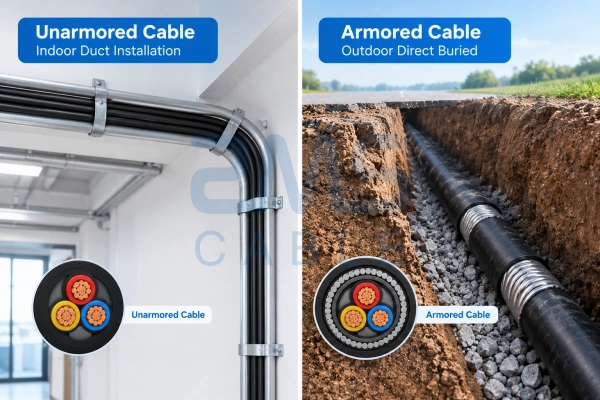
Los cables armados se utilizan principalmente en escenarios como el entierro subterráneo directo., bandejas de cables al aire libre, plantas industriales, cruces de carreteras, y tuberías profundamente enterradas.
¿Qué es el cable no blindado??
El cable no armado es un cable de alimentación básico sin ninguna capa de protección de armadura metálica..
La estructura estándar de cable no armado sólo incluye:
conductor → capa de aislamiento → funda exterior.
Características del cable no blindado: Estructura simple, cable flexible, pequeño radio de curvatura, Fácil instalación, y menor costo.
Los cables no armados carecen de protección mecánica y no pueden soportar la compresión., impacto, o tensión fuerte. Los cables no blindados solo son adecuados para entornos de bajo riesgo, como conductos interiores totalmente protegidos., bandejas portacables cerradas, y cableado del equipo interno.
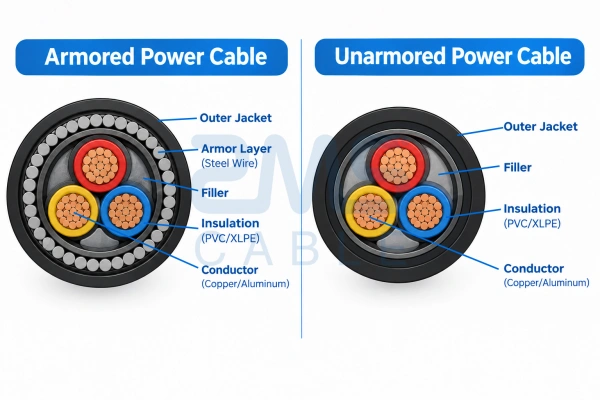
Diferencia entre cable armado y cable no armado
| Escribe | Cable blindado | Cable no blindado |
|---|---|---|
| Estructura | Capa de armadura metálica | Sin capa de armadura |
| Protección mecánica | Resistente a la presión/impacto/tracción, anti-roedores/termitas | Sin protección, fácilmente dañado |
| Instalación | Bajo tierra, entierro directo, trincheras, sitios industriales | Interior, bandejas de cables, conductos, áreas protegidas |
| Características | Duro, pesado | Suave, flexible, luz |
| Esperanza de vida | Muy duradero, de larga duración | Envejece fácilmente al aire libre |
| Costo | Más alto | Más económico |
Tipos comunes de cables armados
| Tipo de armadura | Abreviatura. | Estructura | Aplicaciones clave |
|---|---|---|---|
| Cinta de acero blindada | STA | Cinta de acero doble, alta resistencia al aplastamiento | Enterramiento directo plano, redes municipales, conductos estándar |
| Blindaje de alambre de acero fino | SWA | Alambres finos trenzados, alta resistencia a la tracción | Cruce de río/montaña, suspensión aérea, pozos profundos |
| Blindaje de alambre de acero grueso | CWA | Reforzado con alambre grueso, resistencia a la tracción ultraalta | Suspensión de largo alcance, minería, trabajo pesado |
| Cinta de aluminio blindada | ATA | Ligero, resistente a la corrosión, no magnético | Ambientes de alta corrosión, Campos magnéticos de CA |
Cables blindados vs.. Cables no blindados: Cómo elegir?
Basado en estándares de ingeniería extranjeros y experiencia práctica en el campo., ZMS Cables resume una lógica de selección sencilla:
Escenarios para elegir cables blindados:
- Los cables deben enterrarse directamente bajo tierra;
- al aire libre al aire libre, campo, o terrenos de la fábrica;
- Sitios con riesgos de aplastamiento mecánico, excavación, o impacto;
- Zonas forestales y zonas rurales con picaduras de fauna.;
- Cruzando ríos, torres, o suspensión de gran altitud que requiere resistencia a la tracción.
Escenarios para elegir cables no blindados:
- Instalación totalmente interior, utilizando conductos cerrados y bandejas de cables selladas;
- Cableado interno dentro del equipo.;
- Entorno de construcción libre de daños externos.;
- Presupuesto de proyecto limitado con medidas de protección integrales en todo momento..
Cotizaciones precisas de cable: Información que debe proporcionar como cliente
Muchas consultas en el extranjero adolecen de comunicaciones repetidas y baja eficiencia., principalmente debido a parámetros incompletos.
Hemos recopilado parámetros esenciales para cotizaciones rápidas., a qué ingenieros pueden referirse directamente al enviar:
- Estándar de ejecución: CEI / licenciatura / GB y otros estándares especificados por el proyecto
- Voltaje: 0.6/1kV, 10kV, 35kV, etc..
- Número de núcleos y sección: p.ej., 3×95+1×50mm²…
- Requisitos de blindaje: Armadura de cinta de acero / Armadura de alambre de acero / sin armadura
- Material de la funda: CLORURO DE POLIVINILO / EDUCACIÓN FÍSICA / LSZH retardante de llama y resistente al fuego…
- Entorno de uso: Interior / Entierro directo / Exterior / Corrosivo / Extremadamente frio
- Cantidad de compra, Lugar de entrega, y requisitos de tiempo de entrega
Preguntas frecuentes (Preguntas frecuentes)
Q1: ¿Se pueden utilizar cables armados como cables blindados??
- Los cables armados pueden proporcionar blindaje electromagnético básico, pero no pueden reemplazar los cables blindados dedicados.
- Para alta frecuencia, equipo de precisión, y aplicaciones de medición de alto voltaje, Todavía se requieren cables blindados profesionalmente..
Q2: ¿Se pueden tender temporalmente cables no blindados al aire libre??
- no es recomendable. La exposición a corto plazo acelerará el envejecimiento de la funda., agrietamiento, y entrada de agua, y probablemente provocará una falla en el aislamiento.
Q3: ¿Deben los cables armados estar conectados a tierra??
- Sí. Las especificaciones de ingeniería requieren una conexión a tierra confiable en ambos extremos de la capa de armadura para evitar voltajes inducidos y riesgos de seguridad por fugas..
Q4: ¿Existe alguna diferencia en la capacidad de carga de corriente entre los dos tipos de cables??
- Bajo la misma sección y material., La capacidad de carga actual es básicamente la misma.. La estructura de la armadura no afecta la conductividad., sólo mejora la protección mecánica.
Por qué elegir cables blindados/no blindados ZMS?
Como fabricante de cables que lleva mucho tiempo prestando servicios a contratistas extranjeros y contratistas de EPC, Entendemos que los proyectos en el extranjero tienen mayores requisitos de estabilidad y cumplimiento..
Cable ZMS fabrica su gama completa de cables de alimentación armados y no armados en estricta conformidad con estándares internacionales como IEC, licenciatura, y GB. Los materiales utilizados en los conductores., aislamiento, armadura, y las vainas están totalmente controladas, Eliminación de posibles riesgos de ingeniería, como materiales reciclados y secciones transversales falsamente etiquetadas..
Es más, Podemos proporcionar un conjunto completo de informes de pruebas de fábrica., documentos de calificación, y certificaciones de terceros. También admitimos diseños personalizados para retardantes de llama., resistente al fuego, resistente al frío, y cables resistentes a la corrosión para entornos especiales, Satisfacer las necesidades de diversos proyectos de distribución de energía..
Conclusión
No existe superioridad o inferioridad absoluta entre cables blindados y no blindados.; todo es cuestión de idoneidad para el escenario de aplicación específico. Se prefieren cables sin armadura para ambientes interiores controlados., mientras que los cables blindados son esenciales para el entierro directo al aire libre y en condiciones duras para garantizar un funcionamiento estable a largo plazo..
Si no está seguro de si necesita una construcción blindada o cómo elegir modelos y estándares, envíe los parámetros de su proyecto y el entorno de construcción. El equipo técnico de ZMS Cable proporcionará una solución de selección profesional gratuita y una cotización precisa..