Les câbles armés et non armés sont les deux types de câbles d'alimentation, et ce sont les deux types de câbles d'alimentation les plus couramment utilisés. Câbles d'alimentation tous sont constitués d'un conducteur, isolation des conducteurs, et couche de protection extérieure.
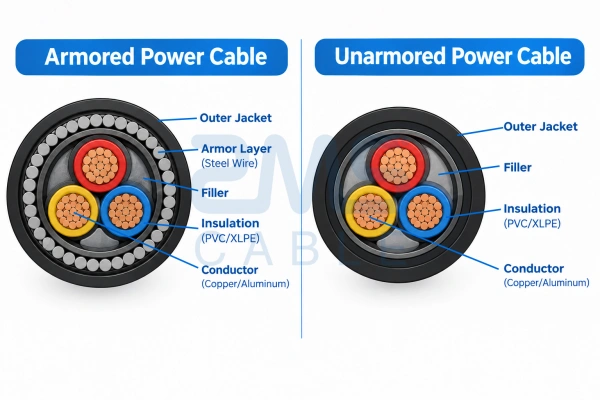
Le différence entre les câbles armés et les câbles non armés réside dans la présence ou l'absence d'une carapace. Par rapport aux câbles non armés, les câbles armés ont un structure de protection métallique, offrant une plus grande résistance à la pression, impact, rongeurs, et résistance à la traction. Ils peuvent être utilisés en enterrement direct, de plein air, et des environnements industriels durs.
Basé sur des années d'expérience dans des projets à l'étranger, ZMS Cables a constaté que la plupart des échecs de projets ne sont pas dus à des problèmes de qualité des produits., mais plutôt à des scénarios d'application incorrects et à des configurations de blindage incompatibles, conduisant à une refonte. Cet article fournira une analyse approfondie de ces deux types de câbles pour aider les clients à atténuer les risques.
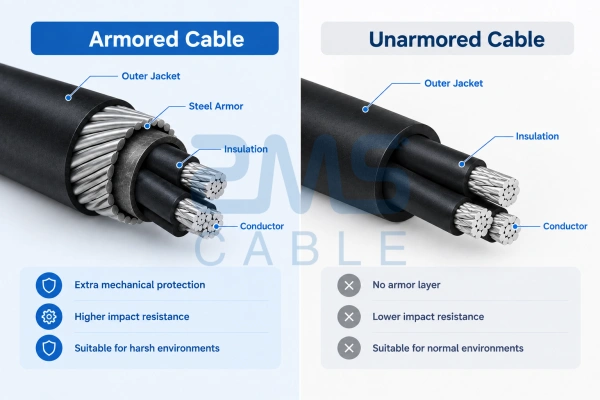
Qu'est-ce qu'un câble blindé?
Qu'est-ce qu'un câble non blindé?
Câble blindé est un câble d'alimentation renforcé avec une couche d'armure métallique supplémentaire entre la couche d'isolation du câble et la gaine extérieure. Les matériaux d'armure courants sont le ruban d'acier et le fil d'acier.; une armure en ruban d'aluminium peut également être utilisée en fonction des besoins.
La structure globale du câble armé, de l'intérieur vers l'extérieur, comprend:
conducteur → couche d'isolation → couche de revêtement intérieur → couche d'armure métallique → gaine extérieure.
La couche d'armure métallique ne modifie pas la conductivité du câble mais peut résister aux forces externes telles que la compression, impact, tension, et les morsures d'animaux, tout en fournissant également un certain degré de blindage électromagnétique.
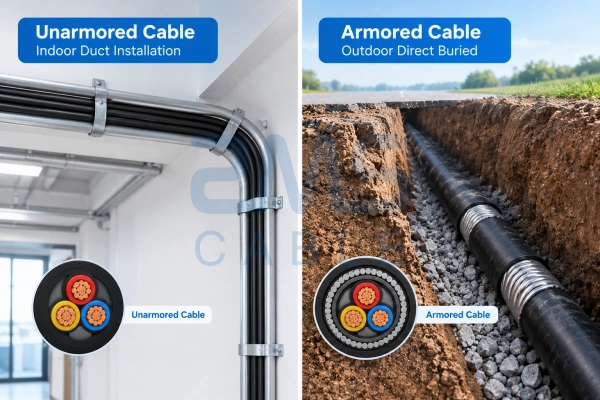
Les câbles armés sont principalement utilisés dans des scénarios tels que l'enfouissement direct sous terre, chemins de câbles extérieurs, installations industrielles, passages à niveau, et pipelines profondément enterrés.
Qu'est-ce qu'un câble non blindé?
Le câble non armé est un câble d'alimentation de base sans aucune couche de protection métallique..
La structure standard du câble non armé comprend uniquement:
conducteur → couche isolante → gaine extérieure.
Caractéristiques du câble non blindé: Structure simple, câble flexible, petit rayon de flexion, Installation facile, et à moindre coût.
Les câbles non armés manquent de protection mécanique et ne peuvent pas résister à la compression, impact, ou forte tension. Les câbles non armés ne conviennent qu'aux environnements à faible risque tels que les conduits intérieurs entièrement protégés, chemins de câbles fermés, et câblage de l'équipement interne.
Différence entre câble armé et câble non armé
| Taper | Câble blindé | Câble non blindé |
|---|---|---|
| Structure | Couche de blindage métallique | Pas de couche de blindage |
| Protection Mécanique | Résistant à la pression/aux chocs/à la traction, anti-rongeurs/termites | Aucune protection, facilement endommagé |
| Installation | Souterrain, enterrement direct, tranchées, sites industriels | Intérieur, chemins de câbles, conduits, zones protégées |
| Caractéristiques | Dur, lourd | Doux, flexible, lumière |
| Durée de vie | Très résistant, longue durée | Vieillit facilement à l’extérieur |
| Coût | Plus haut | Plus économique |
Types courants de câbles armés
| Type d'armure | Abréviation. | Structure | Applications clés |
|---|---|---|---|
| Bande d'acier blindée | STA | Ruban d'acier double, haute résistance à l'écrasement | Enterrement direct à plat, réseaux municipaux, conduits standards |
| Fil d'acier fin blindé | SWA | Fils fins torsadés, haute résistance à la traction | Traversée de rivière/montagne, suspension aérienne, puits profonds |
| Fil d'acier grossier blindé | CWA | Fil grossier renforcé, résistance à la traction ultra élevée | Suspension longue portée, exploitation minière, robuste |
| Ruban en aluminium blindé | ATA | Léger, résistant à la corrosion, non magnétique | Environnements à forte corrosion, Champs magnétiques alternatifs |
Câbles blindés vs. Câbles non blindés: Comment choisir?
Basé sur des normes d'ingénierie étrangères et une expérience pratique sur le terrain, ZMS Cables résume une logique de sélection simple:
Scénarios de choix des câbles blindés:
- Les câbles doivent être directement enterrés sous terre;
- Extérieur en plein air, champ, ou terrains d'usine;
- Sites présentant des risques d'écrasement mécanique, creusement, ou impact;
- Zones forestières et zones rurales avec des piqûres d'animaux sauvages;
- Traverser des rivières, tours, ou suspension à haute altitude nécessitant une résistance à la traction.
Scénarios de choix de câbles non armés:
- Installation entièrement intérieure, utilisant des conduits fermés et des chemins de câbles étanches;
- Câblage interne au sein de l'équipement;
- Environnement de construction exempt de dommages extérieurs;
- Budget de projet limité avec des mesures de protection complètes tout au long.
Devis de câbles précis: Informations que vous devez fournir en tant que client
De nombreuses demandes à l'étranger souffrent de communications répétées et d'une faible efficacité, principalement dû à des paramètres incomplets.
Nous avons compilé les paramètres essentiels pour des devis rapides, auxquels les ingénieurs peuvent directement se référer lors de la soumission:
- Norme d'exécution: CEI / BS / GB et autres normes spécifiées par le projet
- Tension nominale: 0.6/1kV, 10kV, 35kV, etc..
- Nombre de noyaux et section transversale: par ex., 3×95+1×50mm²…
- Exigences de blindage: Armure en ruban d'acier / Armure en fil d'acier / Sans armure
- Matériau de la gaine: PVC / PE / LSZH ignifuge et résistant au feu…
- Environnement d'utilisation: Intérieur / Enterrement direct / De plein air / Corrosif / Extrêmement froid
- Quantité d'achat, Lieu de livraison, et exigences en matière de délais de livraison
Foire aux questions (FAQ)
T1: Les câbles armés peuvent-ils être utilisés comme câbles blindés?
- Les câbles armés peuvent fournir un blindage électromagnétique de base, mais ils ne peuvent pas remplacer les câbles blindés dédiés.
- Pour la haute fréquence, équipement de précision, et applications de mesure haute tension, des câbles professionnellement blindés sont toujours nécessaires.
T2: Les câbles non armés peuvent-ils être posés temporairement à l'extérieur?
- Ce n'est pas recommandé. Une exposition à court terme accélérera le vieillissement de la gaine, fissuration, et infiltration d'eau, et entraînera probablement une défaillance de l'isolation.
T3: Les câbles armés doivent-ils être mis à la terre?
- Oui. Les spécifications techniques exigent une mise à la terre fiable aux deux extrémités de la couche de carapace pour éviter les risques de tension induite et de fuite..
T4: Y a-t-il une différence de capacité de transport de courant entre les deux types de câbles?
- Sous la même section et le même matériau, la capacité de charge actuelle est fondamentalement la même. La structure de l'armure n'affecte pas la conductivité, améliore seulement la protection mécanique.
Pourquoi choisir les câbles blindés/non armés ZMS?
En tant que fabricant de câbles qui sert depuis longtemps les entrepreneurs étrangers et les entrepreneurs EPC, nous comprenons que les projets à l'étranger ont des exigences plus élevées en matière de stabilité et de conformité.
Câble ZMS fabrique sa gamme complète de câbles d'alimentation armés et non armés en stricte conformité avec les normes internationales telles que la CEI, BS, et GB. Les matériaux utilisés dans les conducteurs, isolation, armure, et les gaines sont entièrement contrôlées, éliminant les risques techniques potentiels tels que les matériaux recyclés et les sections transversales faussement étiquetées.
En outre, nous pouvons fournir un ensemble complet de rapports de tests en usine, documents de qualification, et certifications tierces. Nous prenons également en charge les conceptions personnalisées pour les produits ignifuges, résistant au feu, résistant au froid, et câbles résistants à la corrosion pour environnements spéciaux, correspondant aux besoins de divers projets de distribution d'énergie.

Conclusion
Il n'y a pas de supériorité ou d'infériorité absolue entre les câbles armés et non armés.; tout est une question d'adéquation au scénario d'application spécifique. Les câbles non armés sont préférés pour les environnements intérieurs contrôlés, tandis que les câbles armés sont essentiels pour l'enfouissement direct en extérieur et les conditions difficiles afin de garantir un fonctionnement stable à long terme.
Si vous ne savez pas si vous avez besoin d'une construction blindée ou comment choisir les modèles et les normes, veuillez envoyer les paramètres de votre projet et l'environnement de construction. L'équipe technique de ZMS Cable fournira une solution de sélection professionnelle gratuite et un devis précis.