Note: Dans cet article, BT signifie Basse Tension, MT pour Moyenne Tension, HT pour Haute Tension.
Pour les réseaux de distribution d’électricité à l’étranger, projets d'énergies nouvelles et d'infrastructures, LV, Les câbles MT et HT constituent le support principal pour la transmission de l'énergie. De nombreux échecs de projets ne sont pas dus à une mauvaise qualité des produits, mais sélection incorrecte de la qualité de tension ou compréhension insuffisante des lacunes structurelles et de test entre ces types de câbles.
De notre expérience pratique dans le soutien de nombreux projets EPC à l'étranger, de nombreux acheteurs se concentrent uniquement sur la section des conducteurs tout en ignorant les exigences de blindage et de test liées aux tensions nominales. Cela conduit à un échec d'acceptation sur site et à une rupture d'isolation en service.. Cet article couvre les définitions, construction, comparaison, sélection, cas concrets et FAQ pour l'évaluation technique par les ingénieurs et les équipes d'approvisionnement.
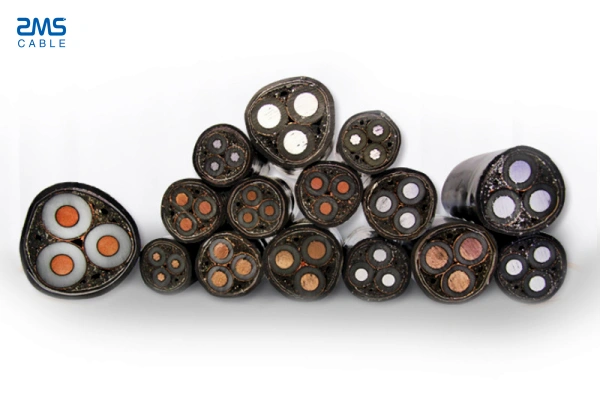
Que sont les LV, Câbles MT et HT?
Classé selon les normes internationales CEI, ces câbles se différencient principalement par la tension nominale. Leurs structures internes deviennent plus complexes à mesure que la tension augmente.
LV (Basse tension) Câbles
- Tension nominale: ≤1kV, généralement 0,6/1kV
- Construction typique: Conducteur (cuivre / aluminium) + isolation + filler + ruban adhésif + gaine extérieure. L'armure est facultative. Aucun blindage semi-conducteur ou métallique n'est requis.
- Caractéristiques: Construction simple, installation flexible et coût d’approvisionnement réduit. Conçu pour la distribution d'énergie de l'utilisateur final vers les bâtiments et les équipements.
- Applications: Alimentation électrique du bâtiment, connexion d'équipement industriel, alimentation temporaire du site, répartition des communautés résidentielles.
Mv (Moyenne tension) Câbles
- Tension nominale: 1 kV-35kV, évaluations communes: 6/10 kV, 8.7/15 kV, 12/20 kV, 26/35 kV
- Construction typique: Conducteur + écran semi-conducteur conducteur + Isolation XLPE + écran semi-conducteur d'isolation + bouclier en cuivre métallique + couche de literie + (armure en option) + gaine extérieure. Les écrans semi-conducteurs intérieurs et extérieurs ainsi qu'un blindage métallique sont obligatoires pour homogénéiser les champs électriques et éviter une défaillance de l'isolation provoquée par une décharge partielle..
- Caractéristiques: Exigences de fabrication strictes. Les tests de décharge partielle sont obligatoires en usine. Convient pour la fourniture d'énergie à moyenne distance.
- Applications: Principaux réseaux de distribution urbains, circuits collecteurs de parcs éoliens et solaires, grands parcs industriels, départs de sous-station.
HT (Haute tension) Câbles
- Tension nominale: Au dessus de 35kV, évaluations communes: 66 kV, 110 kV, 220 kV
- Construction typique: Conducteur + écrans semi-conducteurs multicouches + isolation XLPE épaissie + gaine métallique (plomb / aluminium) + couches barrières à l'eau + (armure en option) + gaine extérieure. Épaisseur de l'isolation, les systèmes de blindage et de blocage d'eau sont bien plus exigeants que ceux des câbles MT.
- Caractéristiques: Seuils de production et de test sophistiqués, conçu pour la transmission de puissance longue distance de grande capacité.
- Applications: Lignes de départ de centrales électriques, transmission interrégionale, tunnels électriques souterrains HT dans les grandes villes.
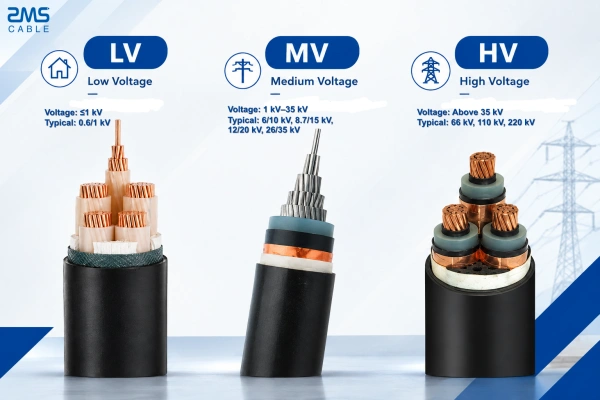
Principales différences entre les VL / Mv / Câbles HT
Basé sur les normes CEI, le tableau de comparaison ci-dessous résume les paramètres critiques pour une référence rapide:
| Article de comparaison | Câbles BT | Câbles MT | Câbles HT |
|---|---|---|---|
| Tension nominale | ≤1 kV (principalement 0.6/1 kV) | 1-35 kV | > 35 kV |
| Écrans semi-conducteurs | Non requis | Conducteur obligatoire & écrans d'isolation | Système de blindage complet de haute précision obligatoire |
| Bouclier métallique | Facultatif | Obligatoire (ruban de cuivre / fil de cuivre) | Gaine métallique scellée obligatoire |
| Test de décharge partielle | Généralement non requis | Test obligatoire en usine | Décharge partielle rigoureuse & tests de préconditionnement |
| Matériau isolant | PVC / XLPE | XLPE / REP | XLPE épaissi avec gaine métallique bloquant l'eau |
| Utilisation typique | Distribution des terminaux des utilisateurs finaux | Répartition régionale & collecte d'énergies renouvelables | Transmission principale longue distance de grande capacité |
| Norme de référence | CEI 60502-1 | CEI 60502-2 | CEI 60840, CEI 62067 |
Comment sélectionner les câbles d'alimentation adaptés à votre projet
S’appuyer sur la pratique des projets à l’étranger, nous avons résumé quatre critères de sélection fondamentaux:
Correspondre à la tension nominale du système: La tension nominale du câble doit être égale ou supérieure à la tension de fonctionnement du système. Ne réduisez jamais les tarifs des câbles. Pour un système 10kV, 0.6/1 Les câbles kV BT ne peuvent pas remplacer les produits MT.
Ampérage & calcul de la distance de transmission: Choisissez des qualités de tension plus élevées pour les circuits à long terme afin de réduire les pertes I²R. Réduire le courant admissible pour une installation directement enterrée ou une pose parallèle multi-câbles.
Environnement d'installation:
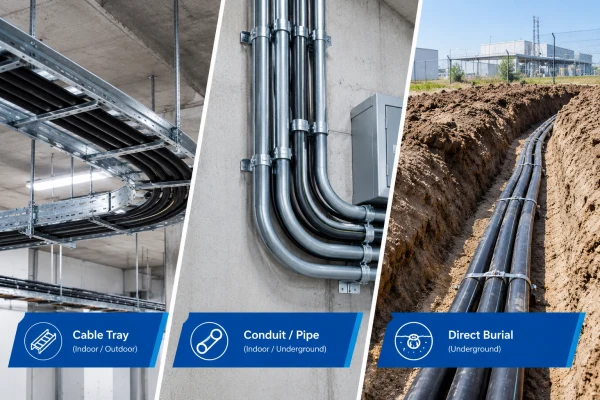
- Enfouissement direct ou goulottes de câbles: Spécifier l'armure (Armure en ruban d'acier STA / Armure en fil d'acier SWA) pour protection mécanique.
- Tunnels ou bâtiments occupés: Donner la priorité aux gaines LSZH à faible dégagement de fumée et sans halogène.
- Sites côtiers ou exposés aux produits chimiques: Déployer des gaines extérieures résistantes à la corrosion.
Normes du projet & règles d'acceptation: Confirmer les normes applicables (CEI / BS / ASTM, etc.). Les exigences structurelles et de test varient et ne peuvent pas être échangées.
Note d'ingénierie: La qualité de tension précède la section du conducteur. De nombreuses erreurs de spécifications résultent du fait que l'on se concentre uniquement sur la taille tout en ignorant les exigences de blindage et d'isolation pour les niveaux de tension cibles..
Informations requises pour le devis de câble d'alimentation
De nombreux appels d'offres s'éternisent en raison de spécifications incomplètes. Préparez les données suivantes pour rationaliser les demandes de renseignements:
- Norme applicable au projet: CEI 60502-1 / CEI 60502-2 / BS, etc..
- Tension nominale: par exemple. 0.6/1 kV, 8.7/15 kV, 110 kV
- Conducteur, quantité de noyau & coupe transversale: par exemple. 3Conducteur en aluminium ×150+1×70mm²
- Exigence d'armure: Non blindé / Armure en ruban d'acier STA / Armure en fil d'acier SWA
- Type de gaine: PVC / PE / LSZH, exigences de résistance aux intempéries ou anti-corrosion
- État de fonctionnement: Directement enterré / plateau / canal; environnement (côtier, basse température, exposition chimique)
- Durée totale de la commande, tambour par unité de longueur, destination de livraison et délai de livraison.
Exemples de sélection de projets
Cas 1: Projet d’alimentation électrique intérieure d’un complexe commercial en Asie du Sud-Est
Tous les câbles circulent sur des chemins de câbles à l'intérieur des bâtiments occupés sans enfouissement direct. La tension de fonctionnement du système est de 0,4 kV. 0.6/1 Des câbles BT LSZH non armés kV ont été sélectionnés, équilibrer les coûts et les performances en matière de sécurité incendie pour la distribution électrique des terminaux des bâtiments.
Cas 2: Circuit de capteurs de ferme solaire en Afrique
10 Circuits de collecte kV sur site, partiellement enfoui directement dans un sol sableux avec risque de dommages mécaniques. Nous recommandons des câbles MT XLPE blindés en ruban d'acier 8,7/15 kV, conforme aux exigences de protection contre les champs électriques et de décharge partielle tout en résistant aux contraintes mécaniques souterraines.
Foire aux questions
T1: Les écrans semi-conducteurs peuvent-ils être retirés de Câbles MT pour réduire les coûts?
Non. Les écrans semi-conducteurs sont un composant obligatoire des câbles MT pour l'homogénéisation du champ électrique. Leur retrait déclenche une décharge partielle et une défaillance prématurée de l'isolation, et les câbles échoueront à l’acceptation des projets internationaux.
T2: Faire Câbles HT offrent toujours une intensité admissible plus élevée pour une section transversale égale?
Non. L'intensité admissible dépend de la section du conducteur, mode d'installation et température ambiante. Une tension plus élevée réduit les pertes de ligne mais n'augmente pas directement la capacité de transport de courant.
T3: Peut blindé Câbles BT être utilisé comme câbles MT?
Absolument pas. L'armure améliore uniquement la protection mécanique. Il ne peut pas remplacer les écrans semi-conducteurs ou les isolations épaisses. L'isolation BT ne peut pas résister aux contraintes électriques de niveau MT et échouera rapidement.
T4: Conducteurs en cuivre ou en aluminium: comment décider?
Le cuivre offre une intensité admissible plus élevée et un diamètre extérieur plus petit. L'aluminium est plus léger et plus rentable. Pour les circuits longue distance, les conducteurs en aluminium avec une section transversale de taille unique peuvent générer des économies substantielles sur le coût total du projet.
Pourquoi choisir les câbles d'alimentation ZMS?
En tant que fabricant de câbles soutenant les entrepreneurs EPC mondiaux à l'étranger, ZMS fournit une gamme complète de câbles d'alimentation BT et MT, avec HT livrable via des ressources partenaires qualifiées.
Nos produits sont conformes à la norme CEI, BS, ASTM et autres normes internationales. Chaque câble MT est soumis à 100 % à des tests de décharge partielle en usine. Des rapports complets d'essais de type et une documentation d'usine sont fournis pour faciliter les appels d'offres et les inspections par des tiers..
Des configurations d'armures personnalisées et de gaines spéciales sont disponibles pour les enfouissements directs., corrosif côtier, Tunnel LSZH et applications basse température. Des joints et terminaisons de câbles assortis peuvent également être fournis pour minimiser les risques sur site causés par des inadéquations d'accessoires..
Conclusion
Il n’y a pas de « meilleur » absolu entre LV, Câbles MT et HT. Le principe de base est de faire correspondre la tension nominale, distance de transmission, environnement d'installation et normes du projet. LV gère la distribution aux utilisateurs finaux, MV dessert les réseaux électriques régionaux, et HV prend en charge la transmission interurbaine longue distance de grande capacité.
Si vous travaillez sur des infrastructures à l'étranger, projets d’énergie renouvelable ou de mise à niveau du réseau et ont besoin d’aide pour Câble BT/MT/HT spécification ou prix, envoyez les paramètres de votre projet, conditions du site et normes applicables. Notre équipe technique peut offrir des conseils de sélection et des devis compétitifs.