How to Choose the Right Submarine Cable: A Procurement Guide

Choosing the right submarine cable is an important decision for offshore wind farms, island power projects, marine platforms, and power interconnection systems. For procurement teams, choosing a cable is therefore about more than voltage and conductor size. The cable needs to match the project route, water depth, seabed conditions, installation method, protection requirements, and applicable standards.

In this submarine cable procurement guide, we explain the key factors buyers should consider when selecting submarine cables and what information should be prepared before requesting a quotation.

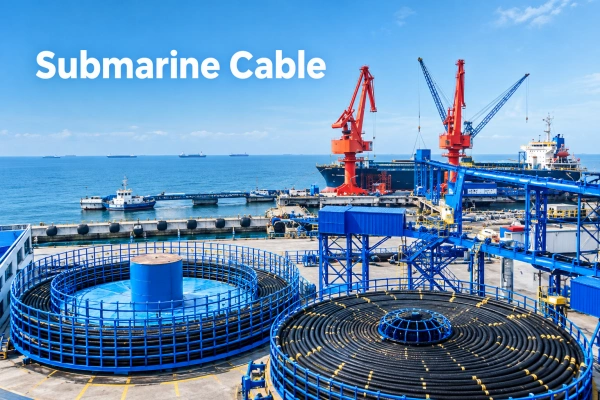
海底ケーブル
海底ケーブル

What Is Submarine Cable?

Submarine cables are specially designed cables that run underwater to carry electricity or transmit communication signals between offshore sites and the mainland. Depending on what they are used for, they generally fall into two main categories: undersea electric cable and subsea fiber optic cable.

Submarine power cables are widely used in offshore wind farms, offshore oil and gas platforms, island power supplies, power connections between the mainland and islands, cross-border power interconnections, and other marine infrastructure.

Our ZMS submarine cable product series is specifically designed for applications including offshore islands, 石油プラットフォーム, power interconnections, and other underwater power transmission projects.

What Are the Main Types of Submarine Cables?

The right submarine cable type depends mainly on the transmission system, 電圧レベル, 応用, and underwater environment.

ZMS submarine cable product range includes HVAC submarine cable, HVDC 海底ケーブル, 海底電力ケーブル, and other specialized submarine cable designs. Our company also provides subsea fiber optic cables for underwater communication applications. The table below gives a quick overview of the main types of submarine cables.

タイプ 関数 トランスミッション媒体 アプリケーション
Submarine Power Cable Power delivery Copper or aluminum conductor Offshore wind projects and island power systems
HVAC Submarine Cable AC power delivery Power conductor Short and medium offshore links
HVDC Submarine Cable DC power delivery Power conductor Long-distance interconnections
海底光ファイバーケーブル Data and signal transmission 光ファイバ Global internet backbone

Want to learn more about ZMS submarine cables for your project? Explore our 海底ケーブル product page for available models and specifications, or contact us directly for a quote and more details.

What Is the Structure of Submarine Cable?

Submarine cable typically consists of several layers, with each layer serving a specific electrical, 機械的, or environmental function.

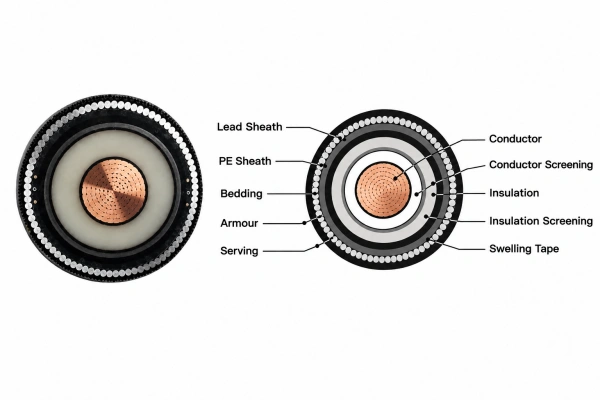
A typical XLPE submarine power cable is made up of several layers, and each layer has a specific job. From the inside out, these may include the conductor, conductor screen, XLPE絶縁体, insulation screen, metallic screen, water-blocking layer, bedding, 鎧, and outer sheath.

  1. The conductor carries the electrical current and is usually made of copper or aluminum.
  2. The conductor screen and insulation screen help control the electrical field around the XLPE insulation. XLPE insulation provides the main electrical insulation. Depending on the cable design, the metallic screen or sheath also provides electrical protection and helps handle fault currents.
  3. Because the cable is installed underwater, water protection is essential. Water-blocking layers and radial water barriers help stop water from spreading through the cable or reaching its inner layers. This helps improve the cable’s long-term reliability.
  4. The cable also needs to cope with mechanical stress during installation and operation. Armor and the outer sheath provide an additional layer of protection. 鋼線装甲, 特に, helps the cable withstand pulling forces, インパクト, 摩耗, fishing activity, and other external stresses.

ZMS medium-voltage submarine cable construction, 例えば, includes a compacted water-blocked conductor, semiconductive screens, XLPE絶縁体, waterproof layers, copper screening, and protective outer layers.

MV submarine cable structure

What Technical Specifications for Submarine Cable Should You Consider?

Choosing the right submarine cable takes more than simply picking a voltage level. You also need to consider how much power or data the cable will carry, where it will be installed, and the conditions it will face underwater.

1. 定格電圧

One of the first things to check is the cable’s rated voltage. Submarine power cables can be used in medium-, high-, or extra-high-voltage systems. The right choice mainly depends on how much power the project needs to transmit and the requirements of the power system.

2. Current-Carrying Capacity

The cable also needs to handle the required operating current without overheating. This is where conductor size becomes important. Factors such as the load, transmission distance, heat dissipation, and seabed conditions all need to be considered when determining the appropriate conductor size.

3. 機械的強度

Submarine cables can be exposed to considerable mechanical forces, especially during installation. The cable needs to withstand tensile loads, 曲げ, pulling forces, and other installation stresses while remaining reliable throughout its service life. This is why factors such as armor design and minimum bending radius are so important.

4. Fiber Count and Bandwidth

For subsea fiber optic cables, the main question is how much data the cable needs to carry. You’ll usually need to consider the number of optical fibers, the required data capacity, and whether the network may need more capacity in the future.

5. 耐食性

Submarine cables spend years in seawater, so corrosion protection is important. The cable materials and protective layers need to handle salt water and long-term exposure to the marine environment. Good corrosion resistance helps the cable stay safe and reliable for years.

How to Choose the Right Submarine Cable?

The right submarine cable depends on the project’s electrical and environmental conditions. Different applications may require different cable designs.

Offshore Wind Farms

These projects usually need cables with high transmission capacity, strong mechanical armoring, good water protection, and a long service life.

Telecommunications Networks

For subsea fiber optic cables, the main focus is on fiber count, 帯域幅, low signal attenuation, and reliable long-distance transmission.

For other applications, factors such as transmission distance, 電圧レベル, water depth, seabed conditions, installation method, and mechanical protection should be considered based on the actual project.

When requesting a quotation, it’s helpful to provide the application, cable length, 電圧, conductor requirements, number of cores, water depth, installation method, armor requirements, applicable standards, and testing requirements. This gives the supplier a clearer picture of the project and helps them recommend the right cable.

If you not sure which submarine cable is right for your project? Just share your basic cable requirements with us. Our ZMS technical team can review your project needs and provide a customized submarine cable solution.

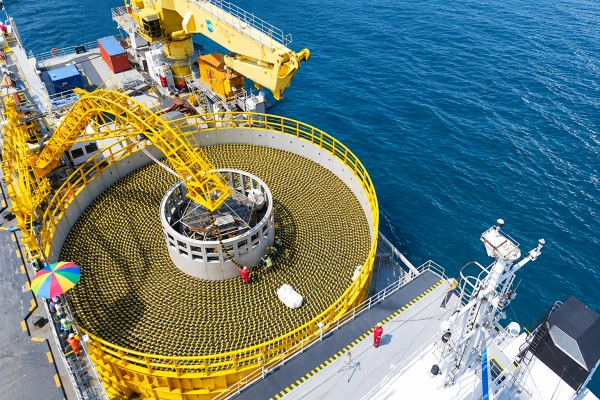
Submarine Cables
Submarine Cables

Why Choose ZMS Submarine Cables?

Choosing the right supplier is just as important as choosing the right cable. At ZMS Cable, we understand that submarine cable projects often come with specific technical and environmental requirements.

We manufacture submarine cables for a range of offshore and underwater applications. Our cables can be made according to international standards such as IEC, VDE, およびICEA, as well as customer-specific specifications.

We also provide customized cable designs based on the actual project. Our team can work with customers on conductor size, 絶縁, water-blocking, 鎧, sheath construction, and other cable requirements to find a suitable solution.

From cable selection and technical consultation to customized design, 製造業, testing, and quotation support, we can provide assistance throughout the procurement process.

If you not sure which submarine cable is right for your project? Send us your basic cable requirements. Our professional team will review your needs and provide a customized submarine cable solution for your project.

ZMS Company
ZMS Company

結論

Selecting the right submarine cable is ultimately a project-specific decision. The best solution is not necessarily the largest, heaviest, or cheapest cable. It is the cable that provides the right combination of electrical performance, mechanical protection, 耐水性, installation compatibility, and long-term reliability.

If you are planning an offshore wind, island power, marine platform, or underwater power transmission project, send us your voltage, conductor size, cable length, water depth, installation method, applicable standards, and project application.

Our technical team can help review your requirements and recommend a suitable submarine cable construction.

Contact ZMS for a free 海底ケーブル Quote and Solutions