The voltage class of 海底電力ケーブル determines its application scenario. 短距離に対応する低圧海底ケーブル, 低電力エンドポイント電源, 一方、中圧海底ケーブルは、島と本土の間、およびプラットフォームと海岸線の間の送電を実際に処理します。. 中圧海底ケーブルの電圧範囲は通常、 6/10 kVから 18/30 kV (with some systems extending to 35 kV), and their power rating is sufficient to cover the auxiliary power loads of an offshore platform.
For business owners targeting overseas contractors and project procurement, the challenge in selecting medium-voltage submarine cables is not “knowing they exist,” but figuring out how model systems, structural layers, and practical applications correspond to one another.
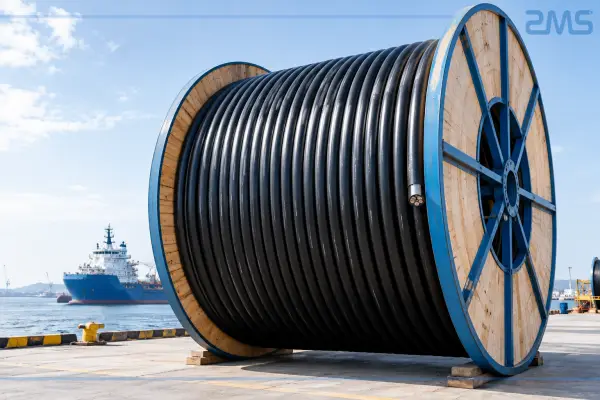
What is medium voltage submarine cable?
Medium voltage submarine cable is power cable with rated voltage in the 6 kVから 35 kV range that is designed and constructed for submarine laying conditions. Medium voltage submarine cable and land based medium voltage cable belong to the same voltage class in electrical principle, but structurally medium voltage submarine cable must additionally solve two problems: radial water blocking and mechanical protection.
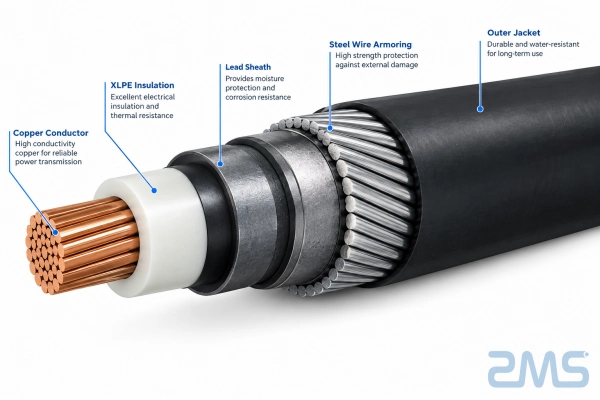
Under long term water pressure, seawater can penetrate through minor defects in sheath into insulation layer. したがって, medium voltage submarine cable usually has metallic sheath (lead alloy or aluminum plastic composite tape) outside insulation shield as radial water blocking layer. At same time, submarine laying, current scour and fishing gear trawling require medium voltage submarine cable to have sufficient tensile and impact resistance, and steel wire armor is standard configuration for this layer. Three core submarine cable mostly uses galvanized steel wire armor, while single core submarine cable requires nonmagnetic armor (such as copper wire or stainless steel wire) to avoid eddy current losses.
As for conductor material, copper conductor is mainstream choice for submarine power cable, because copper at same cross section has current carrying capacity and mechanical strength better suited to long distance, high reliability submarine operating conditions.
Where are medium voltage submarine cables used?
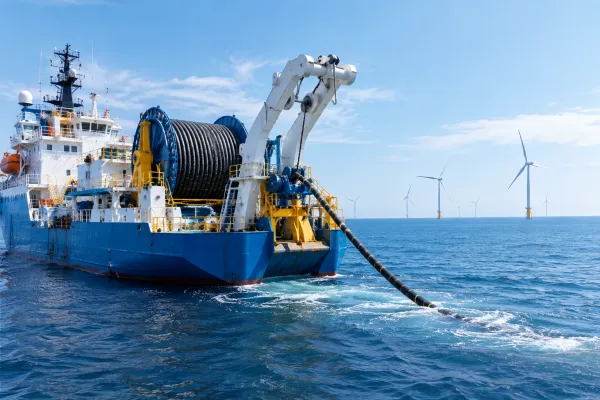
The core use of medium voltage submarine cable is to cross water bodies and deliver power to places that the land based power grid cannot economically cover. Typical scenarios include:
Grid interconnection between the mainland and islands. This is the most mature application of medium voltage submarine cable. Island load is usually in the range of several MW to tens of MW, と 35 kV class submarine cable can complete power supply without introducing high voltage transmission equipment. Statistics for the Croatian Adriatic islands show that 10 kV submarine cable accounts for 46% of local submarine power cable, と 35 kV accounts for 26.6%, with the two combined exceeding 70%.
Power supply for offshore oil and gas platforms. Offshore drilling platforms, production platforms and auxiliary facilities need to draw power from shore or from a central platform, and medium voltage submarine cable is the standard solution.
In field collection for offshore wind farms. Array cables between wind turbines and the offshore substation usually operate at the 33 kV or 35 kV class, which is typical application of medium voltage submarine cable.
River and lake crossings. In inland waters, medium voltage submarine cable is used to replace overhead lines and reduce impact on navigation and landscape.
モデル, Structure and Function of Medium Voltage Submarine Cable
Type designation naming for medium voltage submarine cable differs among standard systems, but the structural layers are similar. ZMS Cable’s medium voltage submarine cable products cover voltage classes such as 6/10 kV, 6.35/11 kV, 8.7/15 kV, 12/20 kV, 18/30 kVと 19/33 kV. Common type designations include XLPE insulation series such as N2XSY, NA2XSY, N2XSEY and N2XSEBY, as well as GB standard system types such as YJV, YJLV and YJSV. The table below summarizes the main structural layers and their functions.
| Layer | 材料 & Configuration | 関数 |
|---|---|---|
| 導体 | Compacted copper or aluminum strands | Carries electrical current |
| コンダクタースクリーン | Semi-conductive material | Controls conductor surface electric field |
| 絶縁 | XLPE | Provides electrical insulation; typically 90°C continuous conductor temperature for the specified design |
| 断熱スクリーン | Semi-conductive material | Controls the electric field at the insulation surface |
| メタリックスクリーン | Copper tape or wire (CTS/CWS) | Electrical screening and fault-current path |
| Radial Water Barrier | Lead-alloy sheath or laminated aluminum foil, depending on design | Limits radial water ingress |
| フィラー & 寝具 | PPロープ, binding tape and PVC bedding, where specified | Maintains cable shape and supports inner layers |
| 鎧 | Galvanized steel wire or specified alternative | Resists laying tension and mechanical damage |
| アウターシース | PVC, PE, LSZH or other specified materials | Provides external environmental protection |
In appearance, medium voltage submarine cable is noticeably thicker and heavier than land cable of the same voltage class: the combination of metallic sheath, armor layer and outer sheath greatly increases the outer diameter and weight per unit length, and the bending radius increases accordingly. Three core construction is the most common in medium voltage submarine cable, because three core armored submarine cable is more economical than three single core cables in laying and mechanical protection.
Features and Advantages of Medium Voltage Submarine Cable
The engineering value of medium voltage 海底ケーブル lies not in “leading” on any single parameter, but in the systematic matching of its structural layers to the submarine environment.
XLPE insulation provides a balance between electrical and thermal performance: the electrical strength, aging resistance and long term operating temperature (90°C) of cross linked polyethylene suit the continuous operating conditions of medium voltage submarine cable.
Metallic sheath provides radial water blocking: lead alloy sheath or longitudinally wrapped aluminum plastic composite tape structure is the core barrier that prevents water penetration in submarine cable, and its reliability has been verified by long term engineering practice.
Armor layer matches the mechanical loads of laying and operation: steel wire armor bears both laying traction and external impact during operation, and the selection logic of nonmagnetic or magnetic armor according to core number directly serves eddy current control.
Voltage class covers mainstream scenarios: the span from 6/10 kVから 35 kV can adapt to different power requirements such as island supply, platform feed and wind power collection, avoiding the mismatch of “low voltage is insufficient, high voltage is uneconomical.”
Why choose ZMS Cable’s medium voltage submarine cable?
ZMS Cable’s medium voltage submarine cable is intended for island interconnection, offshore platform and wind power collection scenarios in the 6/10 kVから 35 kV class. Product structures cover copper or aluminum conductors, XLPE絶縁体, copper tape or copper wire screening, lead sheath or semi dry water blocking structure, as well as steel wire armor and PVC/PE/LSZH outer sheath.
Complete type designation system: European standard and GB standard types such as N2XSY, NA2XSY, N2XSEY, YJV and YJLV can be produced according to project standards.
Structural layers configured according to laying conditions: the metallic sheath form, armor type and outer sheath material are selected according to water depth, burial method and mechanical risk, rather than applying one configuration to all.
Standards and certifications covered: products comply with submarine cable related standards such as IEC 60092-350, IEC 60287, IEC 60332 and NEK 606.
Export packaging and end sealing: steel wood drum packaging and moisture proof end treatment are designed for sea transport and site storage conditions.
If you are evaluating medium voltage submarine cable for island power supply, offshore platform or wind power projects, send the voltage class, conductor cross section, laying water depth and project location to ZMS Cable, and the engineering team will provide structural recommendations and a quotation based on actual operating conditions. Send your inquiry now →