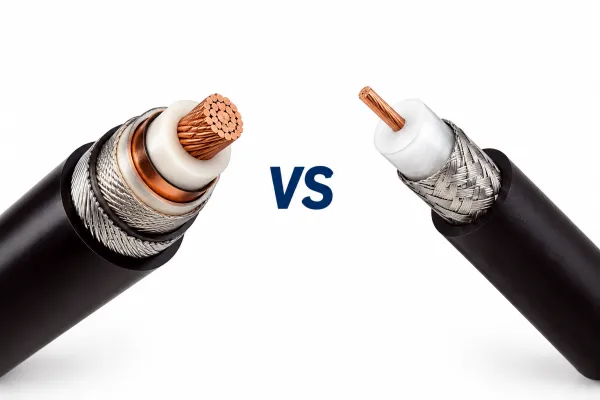
Concentric cable and coaxial cable look very similar, which often leads non professionals to confuse them during procurement, or even assume they are different names for the same product. 사실은, they are two completely different technical routes:
Concentric cable is a power cable, mainly used to transmit electrical power (예를 들어, service entrance cables under the UK BS 7870 기준). Coaxial cable is a signal/communication cable, mainly used to transmit high frequency signals (예를 들어, cable TV and antenna feeders).
Although their appearance may be similar, their internal structure, materials and physical principles are completely different. Below we break down and compare the structures of concentric cable and coaxial cable to help you distinguish them thoroughly.
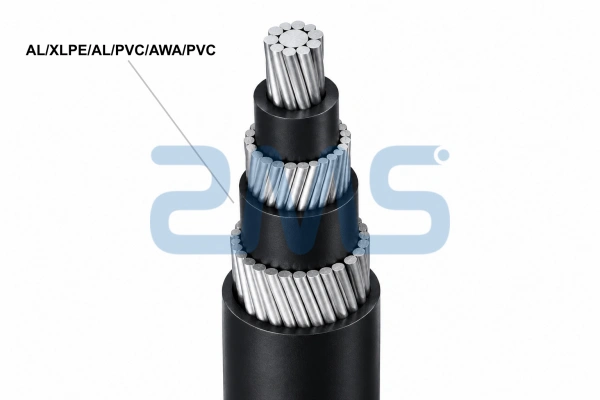
Structure of Concentric Cable
The “concentric” in concentric cable means that the neutral conductor (neutral/earth) is helically wrapped concentrically around the insulated phase conductor.
- Central phase conductor: The material is usually soft annealed copper, 알류미늄, aluminum alloy or copper clad aluminum. It is solid or stranded and is responsible for carrying large currents.
- 절연층: XLPE, PVC or EPR is mainly used. It isolates the phase conductor from the outer neutral conductor.
- Concentric neutral conductor: This is usually bare copper wire or bare aluminum alloy wire, wrapped around the insulation layer in SZ helical or alternating fashion. It serves as both the neutral return path and mechanical protection.
- Filler and tape (for multicore cables): Polyester tape or filler rope is used for shaping, isolation and moisture protection.
- 외피: The outermost layer is usually PVC, LSZH (low smoke zero halogen) or PE, and some cables have armor.
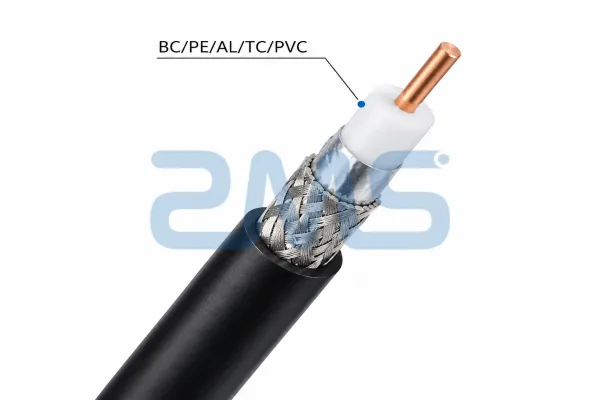
Structure of Coaxial Cable
The “coaxial” in 동축 케이블 means that the inner conductor, insulating dielectric and outer conductor shield share the same geometric center (axis). The signal is transmitted in the space between the inner and outer conductors.
- 내부 도체 (center conductor): The material is usually copper, 주석 도금된 구리, silver plated copper or even copper clad steel. Its diameter and material directly determine signal attenuation and characteristic impedance.
- Insulating dielectric layer: Foamed PE, solid PE or PTFE is mostly used. It not only isolates the inner and outer conductors but also fixes the spacing. The dielectric constant directly determines the impedance (50 Ω or 75 오).
- Outer conductor (shield): Materials include copper braid, aluminum foil plus copper braid, corrugated copper tube, 등. It is the signal return ground and also shields external electromagnetic interference and prevents signal leakage.
- 외피: PVC, PE or LSZH. Black weather resistant PE is commonly used outdoors, and light colors are used indoors.
Concentric Cable vs Coaxial Cable: How to Choose for Different Scenarios?
Types of Concentric Cable
- By core number: 단일 코어 (neutral wire wrapped directly outside the phase conductor) 그리고 multicore (multiple phase conductors stranded together, with neutral wire wrapped outside).
- By neutral form: split concentric (phase and neutral separated, common in UK standard service entrance cables) 그리고 concentric neutral (overall wrapping, common in US standard underground power supply).
- By voltage: 저전압 (600/1000 다섯) has a simple structure; medium voltage (15 케이 V, 25 케이 V, 등.) requires an added semiconductive screen and semiconductive sheath.
- By standard: IEC 60502-1, 학사 7870, ASTM B881, 등., with strict requirements on wrapping method and dimensions.
동축 케이블의 종류
- By characteristic impedance: 50 오 (의사소통, RF, antenna feeders) 그리고 75 오 (cable TV, video surveillance).
- By shielding strength: single braid (basic), aluminum foil plus braid double shield (mainstream surveillance), multilayer shield (high interference resistance) and corrugated copper tube (fully shielded RF).
- By insulating dielectric: foamed PE (낮은 손실) and PTFE (high temperature and high frequency resistance).
Comparison of Concentric Cable and Coaxial Cable
To help engineers and procurement staff check quickly, here is a direct comparison of concentric cable and coaxial cable:
| 차원 | Concentric Cable | 동축 케이블 |
|---|---|---|
| Core function | Transmit power | Transmit signal / RF |
| Structural logic | Phase conductor inside, neutral conductor concentrically wrapped outside | 내부 도체, insulation and outer shield share the same axis |
| Function of outer conductor | Serves as neutral (N) or earth (체육) return path, with protective function | Serves as signal return ground, with electromagnetic shielding function |
| Parameters | Cross sectional area, ampacity, 정격 전압 | Characteristic impedance (50/75 오), shielding attenuation |
| 응용 | Service entrance power lines, low voltage distribution networks, street lighting | 케이블 TV, video surveillance, antennas, RF communication |
Installation Environment and Construction Constraints
Concentric cables and coaxial cables have vastly different requirements for their installation environments; incorrect placement or improper handling can lead to immediate failure:
동심 케이블 (배전):
Primarily used for direct underground burial, building service entrances, or outdoor conduits. Construction constraints: The outer layer of bare copper neutral wires is susceptible to damage during pulling; if the outer sheath is compromised, the cable becomes highly vulnerable to moisture and corrosion once buried. Rough handling or forceful pulling is strictly prohibited; an adequate bending radius must be maintained.
동축 케이블 (Signal Transmission):
Primarily used in indoor low-voltage cable trays, on surveillance poles, or for outdoor antennas. Construction constraints: The internal foamed insulation layer is extremely sensitive to pressure. Sharp bends or “kinks” at corners can cause impedance fluctuations and signal loss. 뿐만 아니라, outdoor connectors must be rendered strictly watertight; the ingress of water will effectively destroy the high-frequency signal.
결론
Concentric cable is designed to deliver “power” safely and economically to homes and businesses; coaxial cable is designed to deliver “signals” to terminals cleanly and with interference resistance. The two cannot replace each other and cannot be mixed. In overseas projects, whether for power distribution or communication surveillance, ZMS Cable can provide high quality cables that meet international standards.
We provide concentric cables compliant with BS 7870 그리고 IEC 60502, as well as various 50 Ω/75 Ω coaxial cables (such as the RG series), meeting full scenario requirements from power to signal. 게다가, the ZMS Cable engineering team will recommend the correct model strictly according to your application scenario (power supply circuit or low voltage signal), avoiding project rework caused by selection errors.
Need to purchase concentric cable or coaxial cable for your project? Please send your specification requirements to our technical team, and we will provide an accurate quotation and technical support.