Diariamente, você depende de cabos para operar equipamentos de fábrica, infraestrutura de energia, salas de servidores e sistemas completos de distribuição de energia. Mas você já parou para pensar: por que um cabo de aparência comum pode fornecer continuamente grandes quantidades de energia elétrica sem vazar corrente ou pegar fogo aleatoriamente?
Many procurement staff and electrical engineers focus only on cable type, ampacity and price, but rarely clarify the most basic operating logic behind it. Understanding how cables work can help you avoid selection mistakes, reduce on-site failures later, and make power distribution projects safer and more reliable. Próximo, we will provide a detailed analysis of the fundamental operating principles and structure of cables, as well as the basic logic for selecting them.
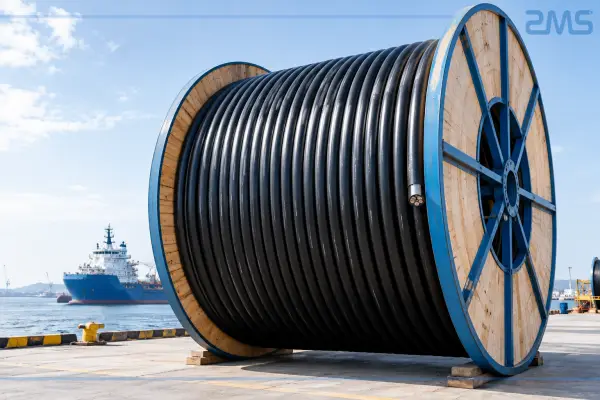
Core Working Principle Of Electrical Cables
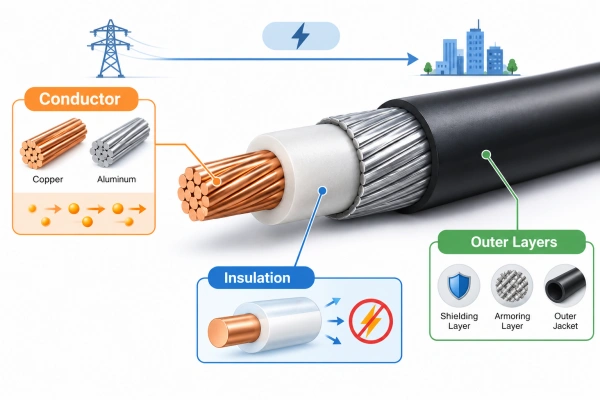
An electrical cable creates a controlled path to move power from one point to another.
1. Condutor (núcleo de fio metálico): The most commonly used material is copper, followed by aluminum. Both have good electrical conductivity.
Microscopic principle: In these metals, the outer electrons are weakly bound by the atomic nucleus and can move freely within the material. When a voltage is applied across the two ends, the electrons move in an orderly way in the same direction, forming what we call electric current.
2. The insulation, blindagem, armor and outer sheath wrapped around the conductor do not conduct electricity themselves. They do not participate in current transmission. Their core task is to confine the current, protect the wire core, and allow the cable to deliver power stably and safely in the corresponding environment.
3.Camada de isolamento: The electrons inside insulating materials are tightly bound and difficult to move freely. It acts like a separation wall, preventing current from escaping the conductor and preventing electric leakage, electric shock and short circuit.
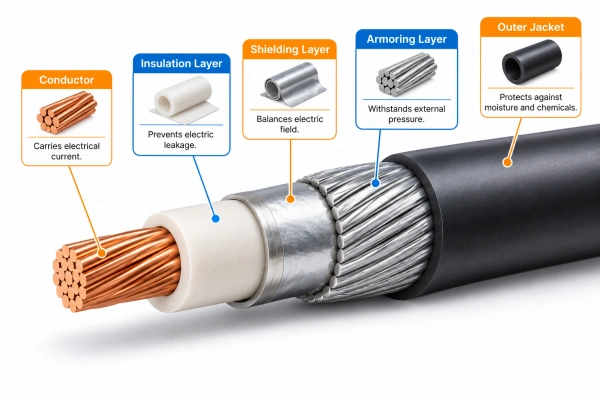
What Role Does Each Layer Structure of Cable Play?
A complete power cable is not just a metal wire. The multilayer structure performs its own functions, and none of the layers is dispensable.
1. Condutor: The carrier of electrical energy. Current flows here, and it is the most core part of the cable.
2. Inner insulation layer: It is close to the wire core and directly isolates the live conductor. It is the most critical layer for preventing leakage. Common materials include XLPE cross linked polyethylene, PVC and rubber.
3. Shielding layer (standard for medium and high voltage cables): It balances the electric field on the insulation surface, avoids local electric field concentration that can break down the insulation, and reduces partial discharge. Many low voltage household cables do not have a shielding layer.
4. Camada de armadura: Usually steel tape or steel wire. It is used in buried, underground conduit and other scenarios where the cable is easily squeezed or scratched, to resist external crushing, stone puncture and animal biting. Overhead cables generally do not need armor.
4.Bainha externa: The outermost protective layer of the cable. It resists moisture, chuva, sunlight and ultraviolet radiation, corrosão química, and isolates acid and alkaline substances in the soil, protecting all internal structures.
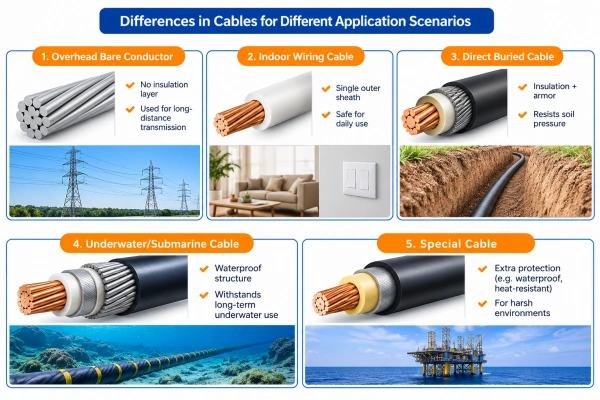
Differences in Cables for Different Application Scenarios
Different installation environments have completely different requirements for cable structure. The core differences come from the insulation, armor and sheath configuration.
1. Condutor desencapado aéreo: It has only a metal conductor and no solid insulation layer. It relies on the surrounding air as the insulating medium and is mostly used for long distance high voltage transmission lines.
This type of cable must not be touched at will, and a sufficient safety distance must be maintained. Once an object bridges two conductors or touches the ground, current leaks out and immediately causes a short circuit or electric shock accident.
2. Indoor wiring cable: Geralmente, it has only an insulation layer plus a simple outer sheath, with no armor. Heat dissipation conditions are good, the environment is clean and dry, and the main purpose is to ensure the safety of daily human contact.
3. Direct buried underground cable: Full configuration of insulation, armor and corrosion resistant outer sheath. There are many stones, pressures, groundwater and corrosive substances underground, so stronger mechanical protection and moisture and corrosion resistance are required.
5.Underwater/submarine cable: It uses aspecial waterproof sealing structure, thickened sheath and water blocking materials to withstand water pressure for a long time and prevent water from penetrating into the insulation layer.
Características de transmissão de CA em cabos
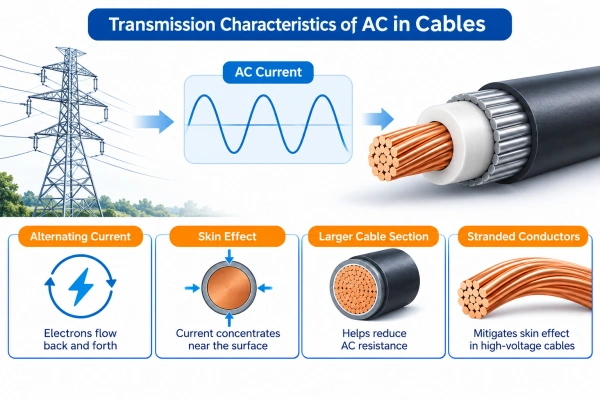
Most of the electricity transmitted in our daily power grids is alternating current, which is clearly different from direct current transmission.
The electrons in AC do not keep running in the same direction, but oscillate back and forth rapidly.
In low voltage scenarios, this difference has little effect. But the higher the voltage and the larger the cable cross section, the more obvious the skin effect becomes: current is more concentrated on the conductor surface, and the utilization rate of the conductor center decreases. This is also why large current high voltage cables often use stranded conductors, to alleviate the skin effect and improve conductive utilization.
Ao mesmo tempo, AC cables generate an alternating magnetic field. High voltage circuits need properly grounded shielding layers to reduce electromagnetic interference with surrounding pipelines and signal cables.
Key Factors Determining Cable Ampacity (Maximum Safe Current)
A cable cannot carry unlimited current just because its wire core can conduct electricity. The maximum current it can safely pass is jointly constrained by multiple conditions.
- Conductor cross sectional area: The thicker the wire core, the larger the conductive path, the smaller the resistance, and the larger the current allowed to pass.
- Material condutor: At the same thickness, copper has better conductivity than aluminum and a higher ampacity.
- Heat resistance grade of insulation material: Different insulations can withstand different maximum temperatures. XLPE has better heat resistance than ordinary PVC.
- Laying method and heat dissipation environment: Overhead installation has good ventilation and fast heat dissipation, so ampacity is higher. Multiple cables laid side by side in a crowded manner, deeply buried in soil, or in sealed conduits have poor heat dissipation, so ampacity must be discounted.
- Ambient temperature: The higher the ambient temperature itself, the more difficult it is for the insulation to dissipate heat, and the allowable current must be reduced.
Risks Caused by Resistance Heating and Insulation Aging
When current flows through a conductor, the conductor itself has resistance, and part of the electrical energy is converted into heat, continuously heating the wire core and insulation layer.
If the current exceeds the limit for a long time, heat continues to accumulate. When the temperature exceeds the upper limit that the insulation material can withstand, the insulation material will slowly soften, crack and become brittle, which is accelerated insulation aging.
After the insulation is damaged and fails, the live conductor loses isolation, and a short circuit between wire cores or leakage from the wire core to ground will occur. In mild cases, it causes tripping and power failure. In serious cases, it generates an arc, ignites surrounding combustibles and causes a fire.
Even if the current is not overloaded, long term sunlight, moisture and chemical corrosion will slowly accelerate insulation aging and shorten cable service life.
Common Root Causes Of Cable Failures
Nearly all cable faults trace back to damaged insulation.
- Mechanical damage: escavação, crushing or sharp stones pierce armour and sheaths. Moisture enters and eventually breaks down insulation.
- Thermal ageing: undersized cables run hot constantly. High heat wears insulation out ahead of schedule.
- Water ingress: broken outer sheaths let water reach insulation. Water trees form under voltage stress and lead to breakdown over time.
- Voltage surges: lightning strikes or grid switching events send sudden high voltage spikes. These spikes can punch through insulation with hidden defects.
Conclusão
Então, how do electrical cables trabalhar? Simplificando, the metal conductor carries electric current, while insulation keeps power safely contained. Extra layers including screens, armour and outer sheaths protect the cable against electric stress, mechanical damage and environmental corrosion. Safe cable performance depends on conductor size, material, insulation rating and installation conditions.
No cabo ZMS, we supply a full range of power cables to match your project needs. Our product lineup covers XLPE insulated power cables, armoured underground cables, overhead conductors and subsea cables for industrial, utility and infrastructure projects. Every cable is built to strict international standards for reliable, long-term operation.
If you need help selecting the right cable for your application, feel free to contact our team. Send us your project details to get an accurate quotation and more technical support today.