Many procurement staff, when selecting cables, see Fire-related markings on the label—including LSZH cables, Flame-retardant cables and Fire-resistant cables—and easily assume that they all belong to the fire protection category and can be used interchangeably.
Many selection errors on projects stem from this misunderstanding. Ordinary LSZH low smoke zero halogen cable does not inherently have fire-resistant capability, and the performance requirements for flame-retardant and fire-resistant are completely different. The two are not interchangeable. Confusing these concepts can easily create safety hazards for the project.
To select the right cable for the project and pass acceptance smoothly, we can break down the three concepts that are often discussed together—LSZH, flame-retardant and fire-resistant—and clarify the boundaries of what each one does.
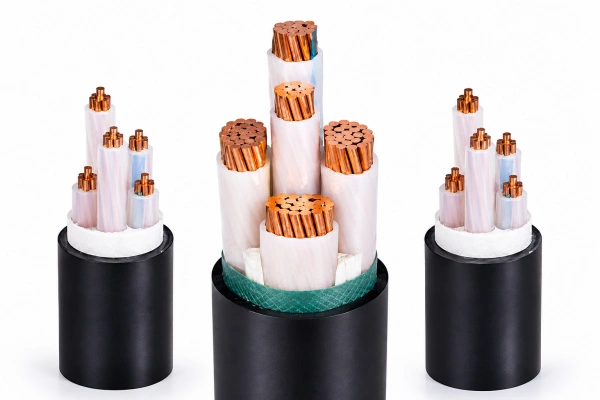
Simple Introduction: Differences Among These Three Cable Types
ЛСЖ (Безгалогенный кабель с низким дымовыделением): Controlling Smoke and Toxic Gases
The design focus of кабель LSZH is to control emissions after the cable burns. In a fire, LSZH cable releases almost no halogen acid toxic gases when burning, and smoke generation is very low, maintaining visibility in evacuation routes and reducing smoke corrosion of equipment. LSZH cable focuses on protecting the escape environment; it does not guarantee that the cable will maintain power supply under sustained direct flame exposure.
Flame-retardant Cable: Preventing Fire Spread
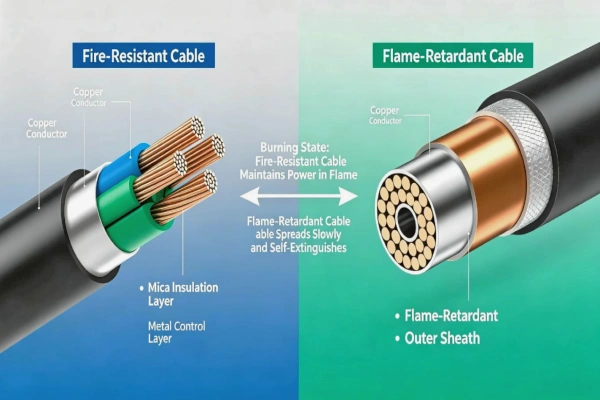
The core characteristic of flame-retardant cable is self-extinguishing. After the external ignition source is removed, the flame on the flame-retardant cable extinguishes by itself, preventing flames from spreading continuously along cable trays and cable passages and limiting the fire to a local area.
Однако, if exposed to prolonged direct flame, the insulation will still melt and carbonize quickly, the conductor will lose insulation protection, and the circuit will be disconnected, making continuous power supply impossible.
Fire-resistant Cable: Ensuring Circuit Survival in Fire
The design goal of fire-resistant cable is to maintain circuit integrity in a fire scenario. Under sustained direct flame action above 750°C, fire-resistant cable can still maintain normal power supply, supporting the continuous operation of life safety equipment such as fire pumps, smoke exhaust fans and emergency lighting, and buying time for evacuation and rescue.
Проще говоря: flame-retardant cable focuses on controlling fire spread, fire-resistant cable focuses on maintaining power supply during a fire, and LSZH cable focuses on low smoke and non-toxicity. These three cable types differ in performance and cannot replace one another.
Differences in Physical Structure and Materials
1) Standard LSZH flame-retardant cable
The insulation and sheath generally use halogen-free polyolefin or XLPE cross-linked polyethylene as the base material, with flame retardants added to the formulation to achieve self-extinguishing performance. Однако, these materials themselves do not have a protective structure for long-term high-temperature resistance. Under sustained high temperature, the insulation fails quickly, causing short circuit and power loss.
2) Огнестойкий кабель
Fire-resistant cable adds a key protective layer: multiple layers of mica tape tightly wrapped around the conductor.
Even if the outer sheath and insulation are burned away by open flame, the mica tape sinters at high temperature to form a dense ceramic insulation layer, separating the phase conductors, preventing phase-to-phase short circuit and maintaining circuit continuity.
Comparison of Technical Standard Systems
The three differ in their test focus and assessment objectives, and each corresponds to a separate IEC international standard.
| Кабельный тип | Стандартный | Test Criteria | Continuous Power in Fire? |
|---|---|---|---|
| Кабель ЛСЖ | МЭК 60754, МЭК 61034 | Smoke density, halogen acid gas release | ❌ No |
| Flame-retardant Cable | МЭК 60332-1 / МЭК 60332-3 | Flame spread distance, самозатухающий | ❌ No |
| Fire-resistant Cable | МЭК 60331, БС 6387 | Circuit integrity at 750°C for prolonged periods | ✅ Yes (90-180 мин) |
Примечание: БС 6387 is more stringent. Its test simultaneously combines flame exposure, mechanical shock and water spray, making it closer to real fire conditions.
Differences in Applications Between Flame Retardant Cables and Fire Resistant Cables
Densely populated public areas (торговые центры, метро, teaching buildings, underground garages)
These scenarios are more suitable for LSZH flame retardant cables. The core requirement of the project is to reduce the hazards of dense smoke and toxic gases while preventing flames from spreading along cable routes, so as to meet safety requirements during evacuation.
Fire emergency life safety circuits (fire water pumps, smoke exhaust fans, аварийное освещение, fire alarm systems)
For these circuits, fire resistant LSZH cables with mica tape are recommended. The LSZH sheath controls smoke and toxic gases, while the internal mica fire resistant layer ensures long term power supply during a fire and supports the stable operation of emergency equipment.
In engineering practice, ordinary LSZH flame retardant cables should not be used to replace fire resistant cables whenever possible. If a fire occurs and the emergency circuit fails prematurely, it will not only create safety risks but also cause the project to fail acceptance.
Why choose ZMS Cable?
Professional expertise: ZMS Cable technical sales team carefully distinguishes flame retardant LSZH cables from fire resistant LSZH cables according to project specifications. We do not deliver ordinary flame retardant cables as fire resistant cables, helping customers avoid acceptance risks and reduce later rework losses.
Кроме того, our products can be supplied with third party test reports for smoke density, halogen acid gas and fire resistant circuit integrity to meet your compliance review requirements.
If you are unsure which fire protection grade your project needs, Пожалуйста, не стесняйтесь обращаться к нам. You can send us the electrical circuit list and the standards required by the project, and ZMS Cable will provide free technical verification, grade selection and solution optimization recommendations.