على قوائم شراء المشاريع الكهربائية, النقاش بين النحاس (النحاس) والألومنيوم (آل) الموصلات لم تتوقف أبدا. في الماضي, تم ربط كابلات الألومنيوم بعدد من حوادث السلامة الناجمة عن تكنولوجيا الإنهاء غير الناضجة في السنوات السابقة, الأمر الذي ترك بعض المهندسين حذرين من كابلات الألومنيوم. اليوم, مع ارتفاع أسعار النحاس, cost pressure is forcing buyers to re-examine aluminum and aluminum alloy options.
Setting aside the “which is better” opposition, from an engineering logic perspective, the choice of conductor is determined not only by ampacity requirements, laying environment and termination conditions, but also by material formulation and processing technology. When assisting overseas EPC contractors in optimizing project BOMs, the ZMS Cable engineering team typically helps customers match the most suitable conductor solution from a life-cycle perspective, avoiding over-performance or under-specification.
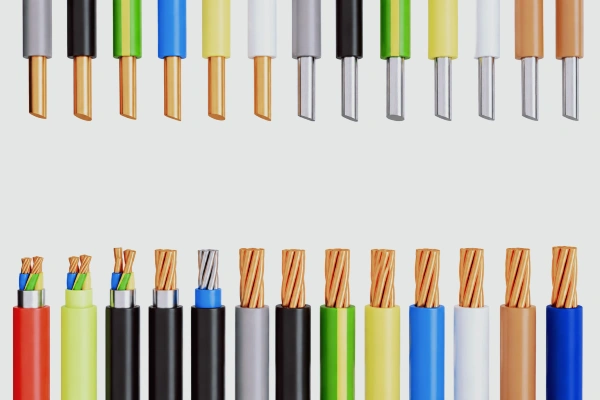
Comparison of Properties for Various Conductor Materials
Based on the IEC 60228 standard and the physical properties of metals, the electrical conductivity and mechanical strength of different materials determine the boundaries of their application.
| Key Indicator | Pure Copper (النحاس) | Pure Aluminum (آل) | Aluminum Alloy (أأ) |
|---|---|---|---|
| الموصلية (IACS) | 100% (Baseline) | ~61% | ~53% |
| كثافة (g/cm³) | 8.89 (ثقيل) | 2.703 (ضوء) | 2.703 (ضوء) |
| قوة الشد | ~220 MPa (Annealed) | ~80 MPa | ~150 MPa |
| التطبيقات النموذجية | General power, الكابلات المرنة | الخطوط العلوية, التثبيت الثابت | Specialty/mechanical cables, PV |
In high-temperature, رطب, or sulfide-containing environments (مثل rubber-insulated cables), tinned copper wire is the better choice. ZMS Cable uses a hot-dip tinning process that produces a dense, uniform tin layer. This layer acts as a physical barrier that effectively prevents the copper conductor from oxidizing and discoloring or from sulfide embrittlement, significantly extending cable life in harsh environments.
في نفس الوقت, all ZMS Cable conductor materials strictly meet environmental requirements. This reduces the carbon footprint while helping your project meet green building and sustainability requirements.
Differences in Cable Conductor Manufacturing Processes
Why are some cables labeled “copper conductor” stiff and hard to bend, while others are extremely flexible? This depends on the annealing process of the copper wire.
- TR annealed soft copper (Treated): After high temperature annealing at 450–650°C, the work hardening caused by wire drawing is eliminated. TR annealed soft copper can be repeatedly bent without breaking, with resistivity as low as ≤17.241 Ω·mm²/km. It is the core choice for all types of flexible cables and mobile cables.
- TY hard copper (Untreated): It is only cold drawn, with severely elongated and distorted grains and a large amount of residual internal stress. TY hard copper is hard and brittle and is prone to breaking under slight bending. It is only suitable for overhead lines or rigid supports in fixed installations.
The annealing process is the watershed in flexible cable performance. ZMS Cable has equipped its production lines with high precision continuous annealing equipment and implements real time monitoring of annealing current and wire diameter. Every batch of soft copper conductor shipped undergoes strict sampling inspection of elongation and DC resistance, ensuring that cables delivered to project sites have excellent fatigue life under frequent bending conditions, such as reels and drag chains.
Classification of Cable Conductor Structures
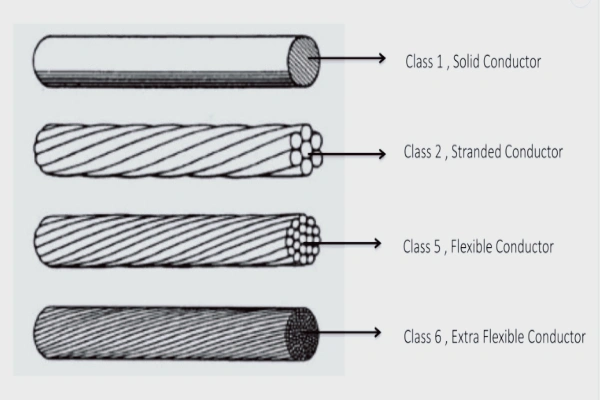
Choosing the right material is only half the job; you also need to choose the right conductor stranding structure. اللجنة الانتخابية المستقلة 60228 classifies conductors into four main categories.
| نوع الموصل | اسم | Structural Features | Main Applications |
|---|---|---|---|
| فصل 1 | صلب | Single wire, هيكل بسيط | Fixed wiring, small cross-section |
| فصل 2 | تقطعت بهم السبل | Regular stranded wires, compacted or non-compacted | Mainstream power cables, 1~800mm² |
| فصل 5 | Flexible | Bunched fine wires, high flexibility | Mobile and flexible cables |
| فصل 6 | Extra-Flexible | Finer stranded wires than Class 5 | Extra-flexible wires, الانحناء المتكرر |
An easily overlooked cross-domain blind spot: aluminum conductors do not have Class 5/6.
In the IEC 60228 معيار, aluminum and aluminum alloy conductors are only defined as Class 1 and Class 2. Because aluminum has poor fatigue resistance, making it into extremely fine aluminum wires makes it very prone to breaking under frequent bending. For any mobile application requiring high flexibility (فصل 5/6), annealed copper conductors must be used.
ZMS has a full set of stranding machines from Class 1 to Class 6. Whether it is large cross-section compacted Class 2 or extra-flexible Class 6, we can ensure precise control of stranding pitch, guaranteeing cable roundness and consistency of electrical performance.
Termination Challenges
When overseas engineers evaluate aluminum cables, what they care about most is often not ampacity, but the reliability of termination. تاريخيا, أكثر من 90% of aluminum cable failures occurred at joints.
- Oxide layer: Aluminum easily forms a dense aluminum oxide film (an insulator) in air. أثناء التثبيت, it must be polished and coated with special conductive paste.
- Creep: The coefficient of thermal expansion of aluminum is about 40% أعلى من النحاس, and alternating hot and cold conditions can easily cause joints to loosen and overheat. Modern aluminum alloys have largely improved this problem.
- Bimetallic corrosion: Directly pressing an aluminum conductor onto a copper terminal in a humid environment will cause a galvanic reaction. Bi-metallic lugs must be used.
When delivering aluminum core cables to overseas customers, the ZMS technical team not only provides products, but also provides termination installation guidance, helping customers avoid later operation and maintenance risks from the source.
Engineering Selection Recommendations for Cable Conductors
Select the conductor type suitable for your project based on your actual application scenario and standard requirements.
| طلب | Recommended Material | اللجنة الانتخابية المستقلة 60228 فصل | Reason |
|---|---|---|---|
| انتقال النفقات العامة & توزيع | آل / Al alloy | فصل 2 | Lightweight Al reduces tower load; stranded structure resists wind tension. |
| Large-section fixed installation (tray/burial) | النحاس / آل / Al alloy | فصل 2 | Al is cost-effective but needs Cu-Al terminals; Cu is maintenance-free with top reliability. |
| Mobile equipment & reels (cranes/frequent bending) | Copper only | فصل 5 / فصل 6 | No Al Class 5/6; TR annealed soft Cu prevents wire breakage under frequent bending. |
| Standard indoor fixed wiring | نحاس | فصل 1 / فصل 2 | فصل 1 solid for small sections (على سبيل المثال, إضاءة), فصل 2 stranded for larger, most cost-effective. |
| Highly corrosive/humid environments | النحاس المعلب | فصل 2 / فصل 5 | Tin coating prevents Cu oxidation/sulfidation embrittlement, ensuring stable conductivity. |
خاتمة
Whether you need TR annealed copper core cables with high conductivity and fatigue resistance, or large cross-section aluminum alloy cables pursuing ultimate cost-effectiveness, the essence of selection is to precisely match material, structural class and project conditions.
As a cable manufacturer with years of export experience, كابل ZMS has complete manufacturing capabilities for copper, aluminum and aluminum alloy conductors. Our products strictly follow international standards such as IEC, BS and VDE, and support multiple certifications including DNV, ABS and CE. We not only provide high-quality environmentally friendly cables, but also offer professional selection support during the project inquiry stage.
If you are evaluating conductor solutions for your next engineering project, welcome to send the load requirements, laying conditions and destination to our engineering team, and we will provide a technically feasible and cost-optimal cable configuration solution.