As countries place increasingly stringent requirements on power grid safety, the problems of traditional bare overhead conductors have become more apparent: tree branches, birds, and severe weather can easily cause line faults, resulting in poor safety. Therefore, whether it’s urban or rural power grid renovation, forest area electrification, or new energy grid connection projects, overhead insulated cables have become an important replacement for traditional bare conductors.
What Is Overhead Insulated Cable?
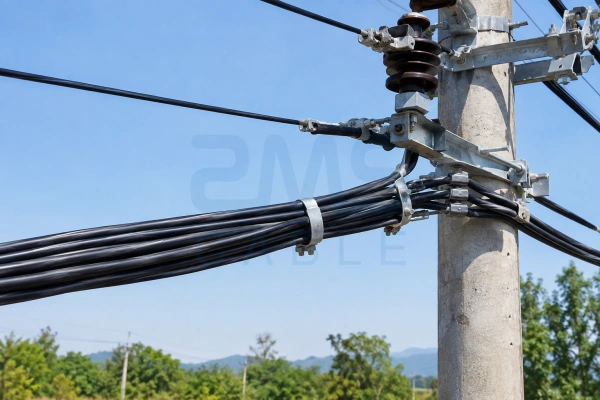
Overhead insulated cable (also known as Aerial Bundled Cable) are power cables specifically designed for outdoor installation on poles. Overhead insulated cable typically use aluminum or aluminum alloy conductors, covered with an outer layer of insulation material resistant to outdoor environments.
For many projects, overhead insulated cables retain the advantages of low cost and simple construction of overhead lines, while solving the problems of unsafety and frequent failures of bare conductors. They are currently the most cost-effective and versatile overhead power transmission solution.
Three Core Points Of Overhead Insulated Cables
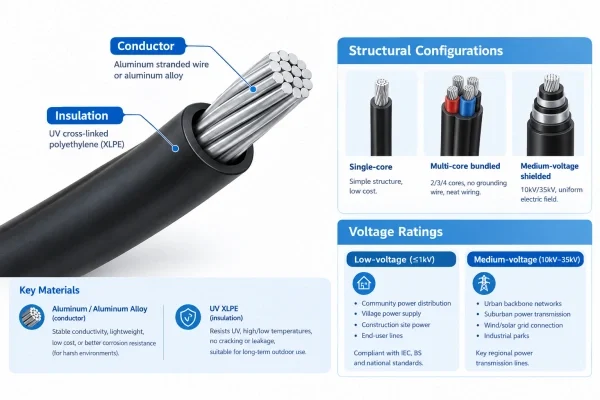
To facilitate ZMS customers in quickly selecting products and accurately matching parameters, we have summarized the entire product system of overhead insulated cables into three core dimensions: materials, structural configuration, and voltage level. All engineering selections, scenario adaptations, and standard matching are based on these three points.
Structure and Materials of Overhead Insulated Cables
The structure of overhead insulated cables mainly consists of two parts: the conductor and the insulation layer. While the material fundamentally determines the outdoor weather resistance, service life, and corrosion resistance of the overhead insulated cable.
Conductor:
Most overhead insulated cables on the market use hard aluminum stranded wire or aluminum alloy as the conductor.
Aluminum has stable conductivity, is lightweight, and has a lower overall cost, making it suitable for most ordinary urban and rural power distribution projects.
For coastal salt spray, chemical pollution, and high-humidity corrosion scenarios, we recommend aluminum alloy conductors, which have stronger corrosion resistance and aging resistance, significantly reducing the repair rate of outdoor lines.
Insulation:
Unlike ordinary indoor cables, overhead insulated cables uniformly use UV cross-linked polyethylene (XLPE) insulation material.
This material has been modified to resist ultraviolet rays and withstand high and low temperatures, allowing it to withstand long-term outdoor exposure to sunlight, wind, rain, and frost without cracking, powdering, or leakage. It is a dedicated insulation material for outdoor overhead applications.
Configuration of Overhead Insulated Cables
Overhead insulated cables are mainly divided into three structural forms, suitable for different projects:
Single-core overhead insulated cable: Simple structure, suitable for upgrading old bare conductor lines, with extremely low construction costs.
Multi-core bundled ABC cable: 2/3/4 cores integrated and bundled, no need for additional grounding wires, neat wiring, smaller line spacing, the mainstream style for overseas urban power distribution networks and rural electrification.
Medium-voltage shielded structure: 10kV and 35kV medium-voltage overhead insulated cables have added inner and outer semi-conductive shielding layers. This ensures a uniform electric field, eliminates partial discharge and insulation breakdown, and meets the safety operation standards of high-voltage main lines.
Voltage Ratings of Overhead Insulated Cables
Following international engineering standards, we classify overhead insulated cables into two main voltage systems, covering all civil and industrial power distribution scenarios:
Low-voltage overhead insulated cables (≤1kV): Suitable for community power distribution, village power supply, temporary power supply at construction sites, and end-user lines, conforming to IEC, BS, and national standards.
Medium-voltage overhead insulated cables (10kV-35kV): Serving as the main power supply lines for urban backbone distribution networks, suburban power transmission, photovoltaic/wind power grid connection, and industrial parks, undertaking core regional power transmission tasks.
Advantages of Overhead Insulated Cables
Based on the design logic regarding materials, structure, and voltage mentioned above, we can summarize the advantages of overhead insulated cables compared to traditional bare conductors. This is the fundamental reason for the widespread upgrade and replacement of overhead cable projects:
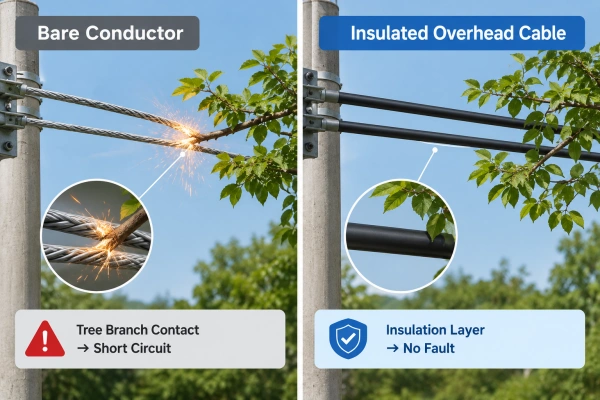
Reduced Failure Rate: The insulation layer can prevent short circuits caused by tree branches or birds, reducing tripping failures by over 70% in forest areas and windy, rainy regions.
Enhanced Safety Level: The insulation layer eliminates the risk of exposed live wires, effectively preventing electric shock and arcing accidents.
Reduced Footprint: The bundled structure reduces the safety distance between lines, eliminating the need for large-scale land acquisition.
Lower Maintenance Costs: Less frequent trimming and cleaning are required, significantly reducing the workload of later maintenance. The overall cost of long-term projects is far lower than that of bare conductor lines.
Standards for Overhead Insulated Cables
Before purchasing overhead insulated cables, it is essential to prioritize matching them to the corresponding standards to avoid acceptance failures:
- General International Standards: IEC 60502
- ASTM B231/B232—Aluminum Conductors
- Commonwealth and African Regions: BS 7870
Applicable standards may vary depending on the region. Cable outer diameter, mechanical tensile strength, insulation thickness, and matching hardware are not interchangeable between different standards. If you are unsure which type is suitable for you, please feel free to contact us; our professionals will be happy to assist you.
How to Choose the Right Overhead Insulated Cable?
Based on years of experience serving overseas projects, ZMS recommends engineers focus on four key dimensions when selecting cables:
- Accurately match the low/medium voltage level to the project’s power distribution system;
- Select the appropriate conductor and insulation material based on the site environment (coastal, high-altitude, forested, industrial areas);
- Choose between single-core retrofit cables or multi-core ABC bundled cables based on construction conditions;
- Strictly adhere to the project’s specified international standards to ensure compatibility during customs clearance, acceptance, and installation.
Why Choose ZMS Overhead Insulated Cables?
As a cable manufacturer with a long history of serving overseas power projects, ZMS consistently mass-produces overhead insulated cables and ABC cables according to international engineering standards, covering a full range from low voltage to 35kV.
All our cables use brand-new weather-resistant XLPE insulation and high-purity aluminum/aluminum alloy conductors, strictly adhering to international standards such as IEC and BS. We provide complete test reports and factory qualification documents to meet overseas bidding and project acceptance requirements.
We also support customization for special environments: cold-resistant, corrosion-resistant, and UV-resistant reinforced versions, as well as non-standard cross-sections and special structures. We provide a complete set of dedicated installation hardware to help engineering teams solve common problems such as mismatched selections, incompatible accessories, and difficulties in acceptance testing.
In summary
Overhead insulation has become an essential product for global power distribution network upgrades, thanks to its mature material structure, tiered voltage system, and stable outdoor performance. Compared to traditional bare conductors, it offers overwhelming engineering advantages in safety, stability, maintenance costs, and scenario adaptability.
Precise material selection, structural matching, and standard alignment are crucial for ensuring the stable operation of overhead lines. If you are unsure about the model, standard, or material of the overhead insulated cable you wish to purchase, please send us your project parameters. The ZMS technical team will provide free engineering selection solutions and accurate quotations.