Overhead bare conductors serve as the primary transmission medium for global overhead power transmission and distribution lines. Unlike overhead insulated cables, overhead bare conductors are directly exposed to the outdoor environment.
Through ZMS’s extensive experience with overseas projects, we have observed that many procurement errors stem from a failure to distinguish between the four mainstream types of bare conductors: AAC, AAAC, ACSR, and ACAR. Selecting the wrong type can lead to various engineering risks. This article provides a comprehensive overview of these four types of overhead bare conductors—covering definitions, classifications, comparisons, selection criteria, pricing, and case studies—to help customers make informed decisions before purchasing.
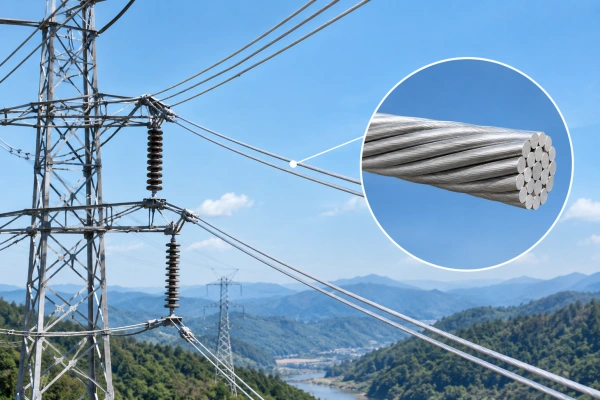
What is Overhead Bare Conductor?
Overhead bare conductor are the oldest and most widely used medium for power transmission. Unlike insulated cables, bare conductors are directly exposed to the outdoor environment, relying on air insulation and insulators mounted on towers to maintain electrical isolation.
This design may seem “crude,” but it is precisely why overhead bare conductors have long been used in high-capacity, long-distance transmission: without the heat-dissipation barrier of an insulation layer, they can operate continuously at higher temperatures, and their current-carrying capacity is significantly better than that of insulated cables with the same cross-section.
From a materials perspective, copper long held a dominant position. However, since the mid-20th century, aluminum and its alloys have almost completely replaced copper in overhead lines.
Aluminum’s conductivity is about 61% that of copper, but its density is only about 30% that of copper. This means that at the same weight, aluminum conductors can provide a larger cross-section and lower resistance, while greatly reducing the mechanical load on towers and construction costs.
At present, the four most widely used types of bare conductors in overhead transmission and distribution lines worldwide are: AAC (All Aluminum Conductor), AAAC (All Aluminum Alloy Conductor), ACSR (Aluminum Conductor Steel Reinforced), and ACAR (Aluminum Conductor Alloy Reinforced). Below, we will break them down one by one.
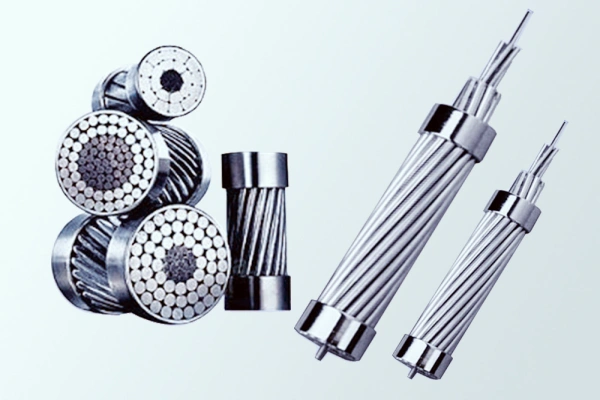
Main Types of Overhead Bare Conductors
AAC: All Aluminum Conductor
AAC is composed entirely of stranded pure aluminum, without any steel or alloy reinforcing core.
Key features of AAC:
- Highest conductivity (up to approximately 61% IACS), offering the best electrical performance among the four conductor types;
- Lightest weight per unit, resulting in low installation and transportation costs;
- Excellent corrosion resistance, making it suitable for urban and coastal environments;
- Lowest mechanical strength, making it unsuitable for long spans or areas prone to heavy ice accumulation.
Typical applications for AAC:
Urban distribution networks and short-span lines.
AAAC: All Aluminum Alloy Conductor
AAAC is constructed by stranding aluminum alloy wires. The material typically used is 6201-T81 aluminum alloy, which incorporates elements such as magnesium and silicon to enhance mechanical properties.
Key features of AAAC:
- Higher mechanical strength than AAC
- Favorable strength-to-weight ratio
- Good electrical conductivity
- No steel core
- Superior corrosion resistance
Typical applications for AAAC:
Coastal and industrial atmospheric environments; medium-to-short-distance distribution lines.
An engineering advantage of AAAC:
Standard AAAC specifications are designed to match the diameters and stranding structures of ACSR; consequently, in retrofit or replacement projects, AAAC can directly replace ACSR of the same specification without the need to redesign towers, poles, or fittings.
ACSR: Aluminum Conductor Steel Reinforced
ACSR is the classic composite conductor structure: it features an outer layer of 1350 aluminum strands and a core of galvanized steel wire. The steel core bears almost all the mechanical tension, while the aluminum layer handles electrical conduction.
Key features of ACSR:
- Extremely high tensile strength, making it the preferred choice for long spans and areas prone to heavy icing or strong winds;
- The steel core content can be adjusted between 6% and 40%, allowing for a flexible balance between strength and conductivity;
- Outstanding cost-effectiveness; it typically has the lowest cost among the four conductor categories;
- The steel core is susceptible to corrosion and requires protection via galvanization or anti-corrosion coatings.
Typical applications for ACSR:
Long-distance high-voltage power transmission, river crossings, and areas subject to heavy icing or strong winds; ACSR is the most widely used overhead conductor globally.
ACAR: Aluminum Conductor Alloy Reinforced
ACAR can be viewed as a “steel-free version” of ACSR: it features an outer layer of 1350 aluminum strands and a core of 6201 aluminum alloy strands, utilizing high-strength aluminum alloy instead of a steel core to provide mechanical support.
Key features of ACAR:
- Superior strength and current-carrying capacity compared to ACSR for the same weight.
- Completely free of ferromagnetic materials, eliminating hysteresis and eddy current losses associated with steel cores.
- Excellent corrosion resistance; no risk of steel core rusting.
- The ratio of aluminum to aluminum alloy strands can be flexibly adjusted to meet project requirements, offering significant customization potential.
Typical applications for ACAR:
Extra-high voltage (EHV) power transmission and specialized projects requiring long spans in highly corrosive coastal environments.
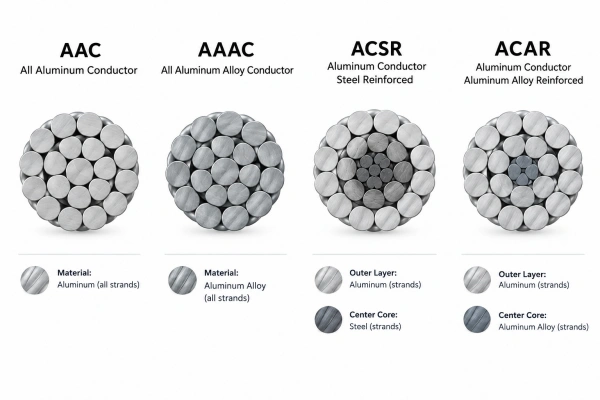
Key Differences Between AAC, AAAC, ACSR, and ACAR
After reviewing the individual descriptions of these four types of conductors, it becomes clear that the choice between them primarily hinges on a few core variables. The following table provides a simple comparison:
| Item | AAC | AAAC | ACSR | ACAR |
|---|---|---|---|---|
| Full Name | All Aluminum Conductor | All Aluminum Alloy Conductor | Aluminum Conductor Steel Reinforced | Aluminum Conductor Alloy Reinforced |
| Tensile Strength | Low | Medium | High | High |
| Conductivity | Highest | Lower Than AAC | Medium | Close to AAC |
| Corrosion Resistance | Good | Good | Fair (Steel Core Is Prone to Corrosion) | Good |
| Typical Span | Short | Medium to Long | Long / Large Crossings | Medium to Long |
| Applications | Urban Distribution and Short Spans | Coastal and Industrial Areas, Medium to Long Spans | Long-Distance Transmission, Large Crossings, and Heavy-Ice Areas | EHV Transmission and Corrosive Environments |
| Relative Cost | Low | Medium | Medium | High |
It should be noted that the comparisons in the table represent typical trends rather than absolute conclusions applicable to all specifications. Even with the same type of conductor, varying mechanical and electrical properties can be achieved through different designs—such as cross-sectional area, stranding structure, material grade, and steel core ratio.
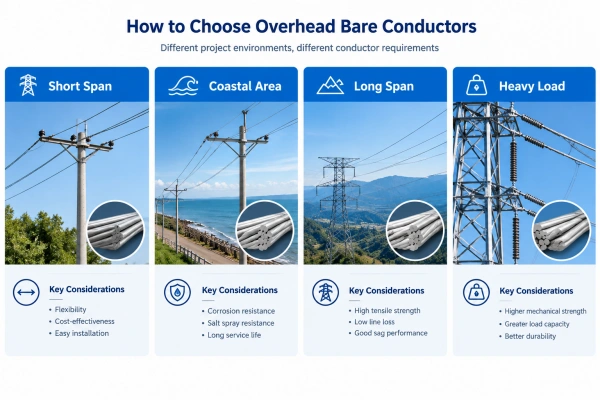
How do you select the right bare overhead conductor for your project?
There is no “one-size-fits-all” answer, but you can quickly narrow down your options by considering the following four questions:
What is the span length?
For short spans (typically under 50–100 meters) with manageable mechanical loads, AAC is the most economical choice. AAAC or ACSR are preferred for medium-to-long spans. For major crossings (such as rivers or canyons), ACSR or ACAR are virtually the only viable options.
What are the environmental conditions at the project site?
In coastal, industrial, or high-humidity areas, AAAC or ACAR should be prioritized to avoid long-term maintenance issues caused by corrosion of the ACSR steel core. Conversely, areas prone to heavy icing or strong winds require the high tensile strength of ACSR to limit conductor sag.
What are the voltage level and ampacity requirements?
High-voltage and extra-high-voltage transmission lines have stricter requirements regarding sag and ampacity, making ACSR and ACAR the more reliable choices. For distribution lines (medium and low voltage), AAC and AAAC are perfectly adequate.
How do you balance initial costs against lifecycle costs?
AAC has the lowest initial purchase cost but is suitable for a limited range of applications. ACSR typically offers the lowest conductor cost per ampere, though long-term maintenance costs for steel core corrosion protection must be factored in. AAAC and ACAR have slightly higher initial costs, but the maintenance savings resulting from their corrosion resistance often offset the price difference over a 15–20 year period.
In actual projects, the ZMS Cable engineering team frequently assists overseas clients with conductor selection based on Bills of Quantities (BOQ) or line specifications. By providing comparative analyses based on span tables, environmental loads, and voltage levels, they help contractors strike the right balance between technical compliance and cost control.
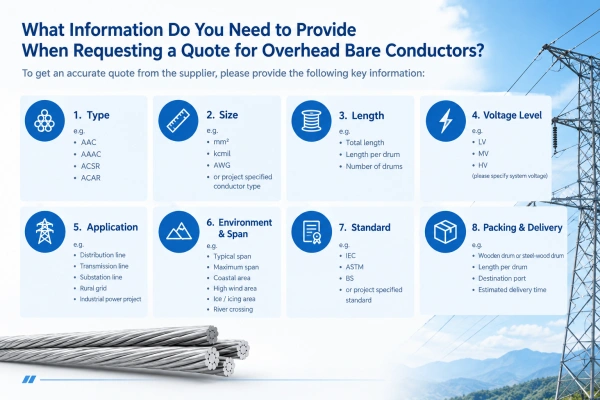
What to Prepare Before Getting a Quote?
If you need an accurate quote from a cable supplier, simply stating “I need ACSR” is usually insufficient.
It is recommended to provide at least the following information:
- Conductor type
- Conductor cross-sectional area or size
- Required quantity
- Project voltage level
- Line application
- Line environment and span length
- Applicable standards
- Packaging and delivery requirements
For example, the information could be provided as follows:
- Project: 35 kV overhead distribution line
- Conductor: ACSR
- Total Length: 20 km
- Typical Span: 180 m
- Installation Environment: Coastal area
- Standard: IEC
- Packing: Wooden drums
- Destination: Port of [country]
With this information, the supplier can further verify details such as conductor construction, cross-section, stranding configuration, mechanical and electrical properties, and packaging requirements. Of course, the final conductor model cannot be determined solely based on the information above; comprehensive calculations regarding factors such as ampacity, maximum sag, tension, environmental loads, and line structure are still required during the engineering design process.
FAQs About Overhead Bare Conductors
Q: Can AAC and AAAC be used interchangeably?
Direct interchange is not recommended. AAAC has significantly higher strength than AAC; if AAAC is used to replace AAC in a design originally specifying AAC, calculations for tower loads and conductor sag must be re-verified.
Q: Will the steel core of ACSR rust?
Yes. The galvanized coating gradually depletes during long-term operation, especially in coastal or industrially polluted environments. Selecting a thicker galvanized coating (such as Class A or Class C) or using anti-corrosion coatings (such as ACSR/AW with aluminum-clad steel cores) can significantly extend service life.
Q: How much more expensive is ACAR compared to ACSR?
The price difference varies based on specifications and market conditions, typically ranging from 10% to 25%. However, ACAR eliminates steel core hysteresis losses, resulting in lower line losses for the same current-carrying capacity; the savings in electricity costs over long-term operation can partially offset the initial investment.
Q: Which of the four conductor types has the highest current-carrying capacity?
For the same conductor cross-section and operating temperature, AAC typically offers the highest current-carrying capacity. However, ACSR and ACAR can achieve higher current-carrying capacities by allowing for higher operating temperatures (since the steel or alloy core bears the mechanical tension).
Why Choose ZMS Cable?
ZMS Cable possesses extensive export experience in the overhead cable sector, serving utility companies and EPC contractors across the Middle East, Africa, Southeast Asia, and South America. Our competitive edge lies not in offering the lowest price, but in the following areas:
- Comprehensive Standards Compliance: We manufacture products according to major standards such as ASTM, IEC, BS, and DIN, and provide factory inspection reports in both Chinese and English.
- Stable Stranding Process: Conductor stranding pitch and tension control directly impact sag characteristics; our stranding equipment features real-time, in-line pitch monitoring.
- Expertise in Export Packaging: We utilize moisture-proof treatments and packaging—optimized for maritime transport—using steel-wood drums to minimize conductor surface oxidation upon arrival.
- Rapid Technical Response: For projects with a clear Bill of Quantities (BOQ), we can provide a quotation package—including detailed technical specifications—within three working days.
If you are seeking a conductor supplier for an overhead line project, please send us your conductor specifications or BOQ; the ZMS Cable engineering team will provide a tailored solution based on your project parameters.
Conclusion
Selecting an overhead bare conductor essentially involves finding the optimal balance between mechanical strength, electrical conductivity, corrosion resistance, and cost. AAC is suitable for short-span distribution; AAAC excels in coastal environments; ACSR is the classic choice for long-span and heavy-load lines; and ACAR offers a steel-core-free alternative for EHV lines in corrosive environments.
Ready to get a quote for your next overhead line project? Send your conductor specifications, quantities, standard requirements, and destination port to the ZMS Cable inquiry email address. Our technical sales team will respond within three business days with a comprehensive quote, including technical data sheets and pricing proposals.